
Specifying Shoe Cabinets for a Target Footwear Range
A practical method for importers, wholesalers and private-label buyers to turn a target footwear mix into a cabinet selection, revision or rejection decision.
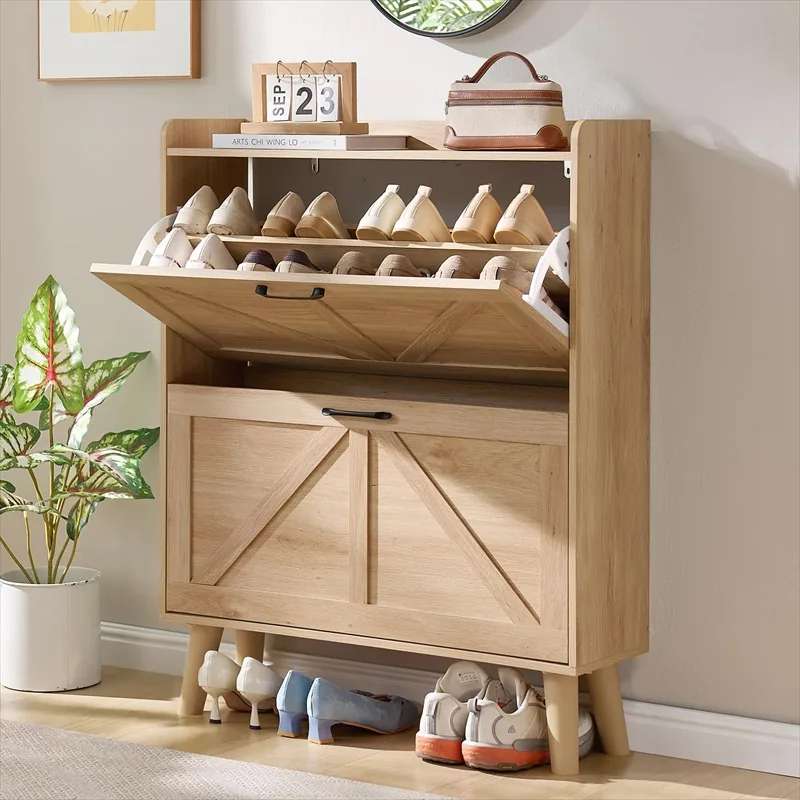
Shown: HOM-SC-011BR with its upper flip-down compartment open. This product photograph illustrates the storage arrangement; it is not a footwear-fit or capacity test record.
Specify a shoe cabinet against an identified set of actual footwear, then compare proposals using that same set. Record whether the shoes enter, whether the cabinet closes and allows normal retrieval, and how many complete pairs from the agreed mix can be stored together. These are separate findings.
For importers, wholesalers and private-label buyers, the useful outcome is a selection decision tied to a cabinet version and configuration. A shoe-size label, an external cabinet dimension or a photograph of a full compartment cannot provide that decision on its own.
Turn the Target Footwear Range into a Sample Set
Start with the footwear your range is intended to accommodate. Identify the required types and the mix to be stored at the same time: for example, low shoes, bulky trainers, heels or ankle boots. Distinguish essential coverage from optional uses. If boots are essential, passing a low-shoe arrangement does not meet the brief.
Give each representative pair a sample ID and record its actual external length, greatest width and overall height, with units and measurement orientation. Include the outsole and any projecting heel, collar or other feature that affects the space occupied. Keep size labels as identification information; they do not replace measurements of the actual shoes.
Select samples that represent different restrictions, rather than relying on one nominally large shoe. The longest outsole, widest sole and tallest upper may belong to different pairs. Record the shape as well as the dimensions, and keep photographs linked to the sample IDs. Measurements support an initial comparison; the shoes themselves establish the fit of their particular shapes.
Define how a complete pair is to be stored: side by side, staggered or in another agreed orientation. State whether pairs may be separated and whether moving another pair to reach the selected shoes is acceptable. Do not flatten uppers or force shoes into a position merely to achieve the requested count. If a proposed arrangement depends on a special orientation, make it part of the recorded configuration.
Map the Cabinet Configuration and the Whole Access Path
Request the proposed cabinet revision, internal layout and applicable installation instructions. Identify usable space at the actual shoe positions, including restrictions from dividers, side fittings, pivots, back panels and front panels. For each proposed divider or shelf position, record the remaining usable length, width and height and the narrowest relevant opening. External width and depth are not substitutes for these fields.
Trace the movement with the sample pair: through the opening, into its resting position, through the closing movement and back out again. With a tilt-out compartment, observe the shoe and compartment together throughout their travel. A shoe resting inside an open front is only one state of that sequence.
Use only divider positions, removal options and operating arrangements confirmed for that product version. Treat an unapproved removal or altered fitting as a proposed design change, not a successful test of the existing cabinet. Ask for the revised specification and installation information before assessing that alternative.
Include the intended installation space in the comparison: skirting-board projection, wall relationship, adjacent furniture or doors, floor conditions and room for the front and the user’s hand to move. Follow the specific product’s assembly and wall-fixing requirements. If the intended site cannot accommodate those requirements, record that restriction; this fit exercise does not establish a generic fixing method, load rating or safety approval.
Keep Three Fit Findings Separate
- Can the footwear be placed inside? Check each identified pair in its agreed position. Record blocked entry, contact points, forced compression or an orientation that differs from the brief. This checks insertion and resting space, not closure or mixed capacity.
- Can it close and be retrieved normally? With the pair in place, close and reopen the front as intended, then retrieve and replace the pair. Record shoe contact, trapping, obstruction or the need to move other footwear. Assess these observations against the buyer’s agreed access requirement. Do not count a pair that fits only with the front left open.
- What complete target mix works together? Load the agreed combination simultaneously, then repeat closure and retrieval checks with the other shoes present. Record the actual pair IDs, quantities and positions. Separate trials of individual pairs do not prove that their combined total can be stored together.
For a capacity statement, count the complete pairs in that successful mixed arrangement and retain the configuration and observations behind it. Keep any shoes placed beneath or beside the cabinet separate from an internal-capacity count. If only part of the target mix has been checked, describe that limited result and leave the rest unconfirmed. Do not extend a result to every shoe carrying the same size label.
Compare Proposals and Make the Selection Decision
Use the same physical shoe set, pairing rules, target quantities and access expectations for every proposal. Identify each configuration separately, even when two configurations use the same cabinet. Record any difference in installation conditions so that a favourable result cannot depend on extra space that the intended location does not provide.
First eliminate or hold proposals that fail an essential requirement. Then compare the usable arrangements: which target pairs fit together, what retrieval involves, which divider positions are needed, and what remains untested. A larger headline capacity is not a like-for-like advantage if it uses smaller shoes, omits the required boots or counts external floor storage.
- Choose an existing structure when its confirmed configuration meets the agreed mix, closure, access and installation requirements. Retain the sample and configuration references behind the decision.
- Request a specification change when a defined restriction could plausibly be addressed within the project brief. Identify the contact point or missing space and ask the supplier to assess compartment proportions, dividers or opening hardware. Confirm feasibility and evaluate the revised sample before accepting it; do not assume that a dimensional change alone resolves the problem.
- Do not adopt the proposal for that brief when it cannot meet an essential footwear or site requirement, or when the required modification is not feasible. A deliberately narrower footwear range is a new brief requiring its own recorded decision.
Hypothetical Example: A Divider Change Alters the Decision
This example is invented and does not describe a HOMVND test. A buyer’s target set contains two pairs of low-top trainers, one pair of bulky trainers and one pair of ankle boots. In proposal A, every pair can be inserted individually, but the ankle boots contact the cabinet during closing. A therefore fails the required mix even though insertion was possible.
In proposal B, a supplier-confirmed alternative divider position reduces the number of storage rows. Assume that the same four pairs can nevertheless be stored together, the fronts close, each pair can be retrieved as agreed, and the installation requirements are met. B can be selected for this four-pair brief despite having fewer rows. That result would not establish its maximum capacity. If the buyer adds another required pair, check proposal B with the expanded set. Proposal A still fails the brief unless its configuration changes or the ankle boots are removed from the requirement.
Keep a Compact, Versioned Fit Record
Use one record per cabinet revision and configuration, with individual pair observations and the final mixed arrangement attached or referenced. The fields below are a record structure, not completed test results. Mark each finding as meeting the agreed requirement, not meeting it or not tested; identify what a missing result prevents you from deciding.
| Record field | What to enter |
|---|---|
| Test identity | Date, reviewer, test-record version, cabinet model and sample ID, drawing revision and instruction version. |
| Target shoe set | Pair IDs, quantities, external length × width × height with units, shape notes and photo references; required simultaneous mix. |
| Configuration | Divider or shelf positions, confirmed permitted options, pairing orientation, position map and measured usable space or opening restrictions. |
| Installation context | Applicable product instructions, site restrictions, opening space and whether the intended installation conditions were represented. |
| Insertion | Result for each pair; entry path, interference, compression or departure from the agreed orientation. |
| Closure and retrieval | Result with the required shoes present; contact points, obstructed movement and any need to remove another pair. |
| Mixed capacity | Complete pairs actually checked together, IDs and positions, closure/access result and any external storage excluded from the count. |
| Decision and open items | Select, revise or decline; untested items, proposed changes, responsible person and required recheck before acceptance or a capacity claim. |
Keep the observations alongside the decision. “Fits” without the shoe set, divider setting and closure result is not enough for another reviewer to reproduce the comparison. Preserve earlier records when a sample or requirement changes, and check the changed area plus any previously successful arrangement that the change could affect.
Use HOMVND Models as Structural Starting Points
HOM-SR-K025 provides a starting point with four vertically arranged tilt-out compartments. HOM-SC-011BR uses two flip-down compartments with alternative internal divider positions. These are confirmed structural descriptions, not results for a particular footwear set.
To compare starting models and discuss bulk orders or customization, explore HOMVND’s OEM and private-label shoe cabinet programs.
For either model, send the target pair IDs, measurements, mixed-storage requirement and installation constraints with your enquiry. Ask which existing configuration can be assessed and which proposed changes need a revised specification or sample. Neither product description establishes the usable clearances, largest suitable shoe size or capacity for your target mix.
Once a configuration is selected, align its drawing, divider arrangement, opening hardware and instructions with the sample reference. Carry forward unresolved items explicitly. The guide to approved furniture samples and production conformity explains why approving an identified sample does not establish conformity of every production unit.