
Cat Tree HS Codes and Customs Classification: A Guide for Importers
A practical guide for cat furniture importers on HS, CN and HTS classification, product facts, official rulings and pre-entry verification.
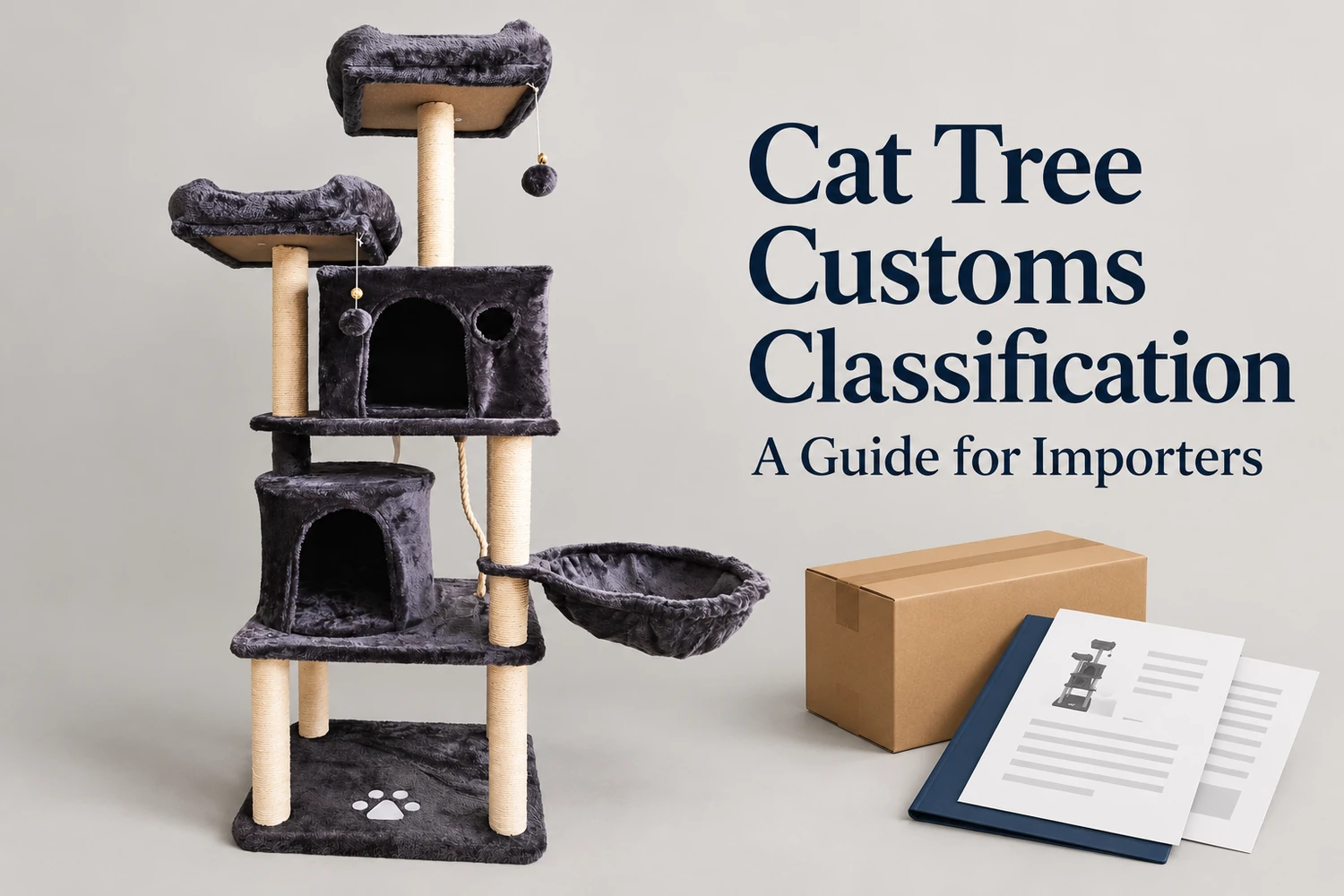
There is no one universal cat tree code that an importer can select from the product name alone. Before choosing a tariff classification, identify the destination market and document the product as imported: its materials, components, construction, functions and whether it is shipped assembled or unassembled. Then test the possible headings against the current tariff schedule, legal notes and applicable classification rules for that market.
This guide explains that process for importers, wholesalers, ecommerce sellers and private-label brands. It uses official European Union and United States sources to show why apparently similar cat trees may require different analysis. It is a purchasing and documentation guide, not a tariff ruling for a particular SKU.
Start with the destination market, not a supplier’s product name
The World Customs Organization describes the Harmonized System as an international product nomenclature built around six-digit codes. Participating economies extend that common foundation for their own tariff and statistical purposes.
That distinction matters when a buyer asks for a “cat tree HS code.” The question may refer to several different levels:
- HS: the international six-digit foundation maintained through the WCO framework.
- EU Combined Nomenclature (CN): the European Union’s eight-digit development of the HS, updated annually. The European Commission’s CN page points users to the applicable annual version.
- EU TARIC: the EU’s integrated tariff database for tariff and commercial-policy measures. The Commission notes that TARIC is updated as measures change and does not contain national VAT or excise information.
- U.S. HTS: the Harmonized Tariff Schedule of the United States. According to the USITC HTS FAQ, the four- and six-digit levels reflect the international HS structure, while the eight- and ten-digit levels are specific to the United States; legal tariff provisions extend through eight digits and import reporting uses ten digits.
A code used by a factory or on an export declaration can therefore be a useful reference, but it is not automatically the complete destination-market code. The importer or its appointed representative should validate the declaration in the destination system and for the relevant import date.
Why the words “cat tree” do not settle classification
Commercial labels help buyers find products; tariff headings classify goods by legal text and objective product characteristics. The USITC expressly warns that the HTS is not a list containing the name of every product and that a keyword result is not enough: users must consider the heading language, legal notes and General Rules of Interpretation.
A typical cat tree is also a composite article. A single unit may combine engineered wood or plywood platforms, paperboard or other cores, plastic end parts, metal fasteners, woven or knitted fabric, plush, sisal rope or matting, and sometimes a cabinet or other enclosed structure. Which component gives a particular product its essential character cannot be decided from the category name alone.
Record at least the following facts before asking a broker or customs authority to review a candidate classification:
- Destination and timing: importing country or customs territory and intended entry date.
- Exact SKU and revision: product identifier, option or configuration, and the version actually being shipped.
- Component-level materials: the material and function of each base, platform, post, enclosure, covering, scratching surface and significant fitting.
- Composition data: available weights, quantities, dimensions, surface coverage and values where they are relevant to distinguishing components or materials.
- Construction and function: how the structure is supported, how parts connect, and which surfaces allow climbing, resting, hiding, playing or scratching.
- Condition at import: assembled, disassembled or presented as a kit, including what arrives together in the shipment.
- Supporting records: BOM, drawings, product photographs, assembly instructions, packaging list and a sample if the authority requests one.
The same discipline used to distinguish freestanding, wall-supported, wall-mounted and tension-supported products in our Cat Tree Structure Types guide is useful here: identify the actual construction instead of relying on a loose market label. Our cat tree materials guide can help buyers name common components, but it does not assign customs codes.
What official EU decisions show
Official decisions are most useful when their product facts are read together with the result. They are not a shortcut that converts every product sold as a cat tree into the same code.
| Official source | Product facts that mattered | Decision and usable lesson |
|---|---|---|
| Commission Implementing Regulation (EU) No 1229/2013, 28 November 2013 | A roughly 40 × 40 cm wooden platform, a 60 cm paperboard tube, plastic end pieces, polypropylene fabric, plush and a woven sisal mat with latex backing. | The annex classified that described article in CN 6307 90 98. For those facts, the textile materials were considered to give the article its essential character for scratching, sitting and playing. The result supports fact-specific composite-goods analysis, not a universal code. |
| Commission Implementing Regulation (EU) No 350/2014, 3 April 2014 | A textile-covered wooden box, textile-covered wooden platforms, paperboard tubes covered with sisal cord, and polyester plush; the woven textile surface exceeded the sisal surface. | The annex also classified that described article in CN 6307 90 98. The reasoning compared the role and quantity of the textile materials. It does not establish that every product containing wood, sisal and plush reaches the same result. |
| Court of Justice of the European Union, Case C-24/22, PR Pet, judgment of 22 June 2023; see also the published operative part. | Cat scratching articles combined a structure with coverings such as sisal rope or fabric, water-hyacinth rope, plush, felt and synthetic materials for cats to occupy, play on and scratch. | The Court held that the goods described did not fall under CN heading 9403. They were to be classified under the heading corresponding to the material present to the greatest degree among the materials covering the structure, for the referring court to determine. If those covering materials were present in equal proportions, GRI 3(c) required the heading occurring last in numerical order among those equally meriting consideration. This holding concerns the goods described in the judgment; it is not a universal cat tree code or a general algorithm for every construction. |
These sources show why a buyer should preserve the full materials and construction record. In C-24/22, “present to the greatest degree” refers to the materials covering the structure; the judgment does not define that comparison as weight, surface area or value alone, and it does not merge the internal structure with its external coverings. For purchasing and customs review, record the types and distribution of the covering materials separately from the structural materials. A “wooden cat tree” label is not enough. Nor do these sources justify copying CN 6307 90 98 onto a different product without checking the current CN, TARIC measures and the specific facts.
How to verify a U.S. cat tree classification
For a U.S. import, start with the current HTS heading text, relevant section and chapter notes, and the applicable classification rules. The USITC recommends using CBP CROSS as a research source when the HTS search and legal text do not resolve the question. Compare a ruling’s materials, structure, use and condition as imported with the actual product; a matching product name alone is not enough.
A supplier’s export code cannot automatically serve as the U.S. import code because national subdivisions after the international six-digit level may differ. If the importer needs a binding classification conclusion for a prospective transaction, follow the CBP binding-ruling procedure and use the eRulings submission service.
From a candidate code to an import-ready classification record
- Freeze the product version being reviewed. Record the SKU, configuration and revision. If materials or structural parts change, reopen the classification check rather than assuming the earlier analysis carries over.
- Build the product fact file. Assemble the component-level material list, drawings, photographs, dimensions, available composition data, assembly manual and shipment presentation.
- Identify candidate headings. Use the current destination-market tariff, then read the heading language, section and chapter notes, and applicable interpretation rules. Do not stop at a keyword search.
- Compare official decisions cautiously. Search for decisions involving materially similar construction and presentation. Note both the similarities and the facts that differ.
- Check the live destination system. For EU imports, confirm the current CN and relevant TARIC measures. For U.S. imports, confirm the current HTS provision and statistical suffix rather than relying on a foreign or historical code.
- Obtain qualified review. Give the same controlled product file to the customs broker, trade counsel or competent authority. Ask the reviewer to state which product revision and facts support the conclusion.
- Escalate material uncertainty before entry. In the EU, Binding Tariff Information (BTI) provides a legal classification decision for the specified goods. It is generally valid for three years and binds EU customs administrations and the holder, although it may be annulled, cease to be valid or be revoked earlier in defined circumstances. In the United States, CBP provides a binding-ruling program and the eRulings submission service for prospective transactions.
- Retain the decision trail. Keep the submitted facts, reviewer or authority response, date, tariff version and any assumptions with the purchasing and import records.
For an EU BTI application, the Commission says to make a separate application for each type of product and describe the goods in detail, with images or samples where possible. Inaccurate or incomplete application information can result in annulment. BTI decisions are published for transparency, but finding another trader’s public decision does not make it binding for a different importer; the binding effect applies to EU customs administrations and the holder of that decision.
For the United States, the USITC states that it does not issue legally binding classification advice; CBP is the authority for binding rulings. The division of responsibility is important: a tariff database helps research a candidate provision, while a binding decision comes from the competent customs authority.
Keep classification separate from other import questions
Classification does not determine origin, customs value, product safety compliance, labeling compliance or every additional duty and trade measure. These issues can interact at entry, but each requires its own facts and legal analysis.
- The tariff rate must be checked for the destination, code and entry date.
- Preferential origin and country-of-origin marking follow rules that are separate from tariff classification.
- Trade remedies, quotas, licensing requirements and other measures may depend on classification plus origin or other facts.
- EU TARIC does not include national VAT and excise information, so those amounts require a separate destination-country check.
A confirmed classification is therefore one input to landed-cost planning, not a complete landed-cost calculation. Buyers who are still defining the product assortment can use the broader Cat Tree Sourcing Guide for product and supplier questions, or review the current HOMVND cat tree collection. Those pages do not replace customs verification.
Frequently asked questions
Is there one HS code for every cat tree?
No. “Cat tree” is a commercial category, while customs classification depends on the destination tariff and the objective characteristics of the imported goods. Official EU decisions show that material composition and the role of components can drive the analysis, and the CJEU has rejected heading 9403 for the specific scratching articles before it. That is not a universal code for different constructions.
Can an importer use the code supplied by the factory?
Treat it as an input, not an automatic destination-market answer. The international HS foundation ends at six digits, while the EU, United States and other markets add their own subdivisions. Confirm that the supplier reviewed the same SKU and revision, then validate the full code under the destination’s current schedule.
Does the material with the highest weight always control?
No. For the goods described in C-24/22, the Court directed classification by the material present to the greatest degree among the materials covering the structure, with the referring court responsible for that factual determination. The judgment does not say that “greatest degree” always means weight, surface area or value alone. It also does not convert that case-specific holding into a rule for every cat tree construction.
When should an importer seek a binding ruling?
Consider it when the classification remains materially uncertain after review, when the commercial exposure warrants legal certainty, or when closely competing headings would materially affect entry treatment. Apply prospectively and submit a complete, revision-specific description. Your broker or trade adviser can help decide whether an EU BTI application, a U.S. CBP ruling request or another destination-market procedure is appropriate.
Prepare the product facts before asking for the code
For a private-label project, send HOMVND the target market, reference model and intended purchasing configuration. As a B2B cat furniture manufacturer and supplier, HOMVND will confirm which model-specific material, structural, assembly and packaging information is available for the project. The importer or its customs broker can then use the same product description for classification review. HOMVND does not issue customs classifications or approvals.
Request a Cat Furniture Quotation and include the target market, reference model and purchasing configuration.
Official sources checked 26 October 2026. Tariff schedules, measures and ruling status can change; verify the live destination-market position before entry.