
Cat Tree Import Compliance Documents: EU and U.S. Buyer Guide
An EU and U.S. buyer guide to matching cat tree safety records, composite-wood evidence, labels and test reports to the exact product and market.
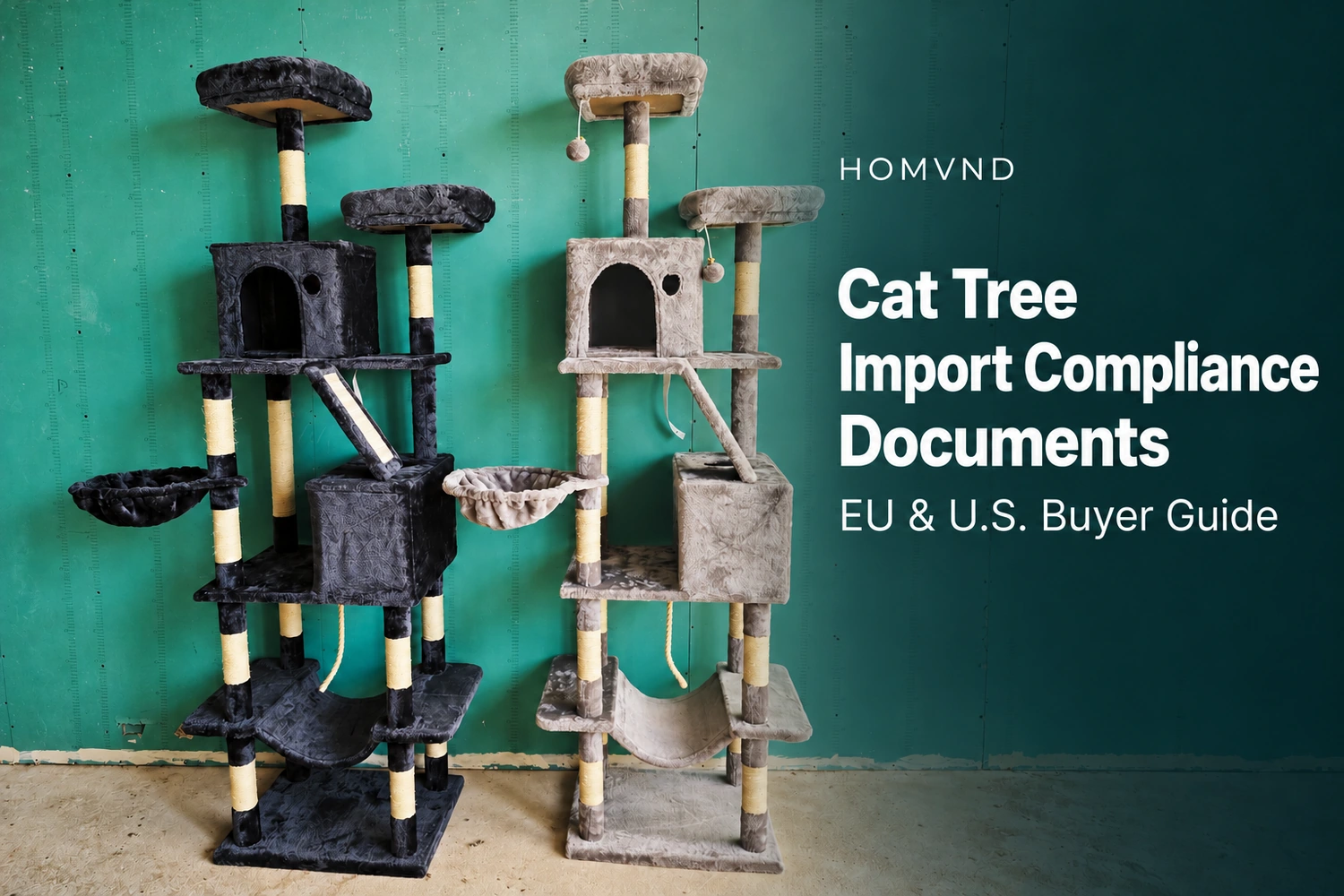
Before importing a cat tree into the EU or United States, request a product-specific evidence file rather than a generic “compliance certificate.” Match the destination, component materials, construction and brand identity to the applicable requirements, then check whether each declaration, test report and label actually covers the version you intend to buy. A board report, an assembled-sample inspection and an importer’s declaration answer different questions.
For importers, wholesalers, ecommerce sellers and private-label brands buying in bulk, this review is most useful before materials and labeling are locked. This guide covers ordinary, non-electrical household cat trees and scratching structures. Powered accessories and other special functions need a separate applicability review. It is a document-review guide, not a finding that a particular HOMVND model meets every requirement.
Define the product that the documents must cover
Two cat trees with similar photographs can require different evidence. A plush covering can conceal MDF, particleboard, plywood or another substrate; a wood-look finish does not identify the board beneath it. A freestanding tower and a wall-mounted platform also have different installation conditions. These differences should appear in the product file before reports are compared.
- Product identity: model, configuration, drawing or specification revision, photographs and intended household use.
- Materials by component: base, platforms, enclosure, post cores, scratching surfaces, textiles, backing, adhesives, finishes and fittings. Record the actual board type instead of “wood.”
- Assembly and installation: final hardware, manual revision, support method and any specified wall attachment.
- Market and commercial identity: EU destination countries or U.S. destination, sales channel, brand owner, importer and planned market-entry timing.
The cat tree materials guide explains component definitions. Here, those definitions establish what a document must identify; they do not establish chemical compliance or structural performance.
EU: build a safety file, traceability and usable product information
For products within its scope, the EU General Product Safety Regulation, Regulation (EU) 2023/988, connects product safety to technical documentation and economic-operator responsibilities. Under Article 9, manufacturers must perform an internal risk analysis and prepare technical documentation describing the product and its safety-relevant characteristics. Risk analysis, mitigation measures and relevant test outcomes belong in that file as applicable to the risks.
For a cat tree, a practical file should connect the actual structure, connections, accessible surfaces and installation instructions to the identified hazards and the evidence used to address them. A report on one platform does not explain the behavior of a taller assembly with different supports. Photographs of a finished sample cannot replace the underlying assessment.
Article 11 requires importers to verify specified manufacturer obligations. Under Article 11(6), importers must keep a copy of the technical documentation referred to in Article 9(2) at the disposal of market surveillance authorities for 10 years after placing the product on the market, and ensure the relevant documents can be provided to those authorities on request. Review the following with the EU party responsible for placing the product on the market:
- Product identification that connects the unit or packaging to the model and traceable batch or other identifier.
- Manufacturer and importer names, registered trade names or trademarks, postal addresses and electronic addresses; under Articles 9(6) and 11(3), place these on the product or, where that is not possible, on its packaging or an accompanying document. Identify the Article 16 EU responsible economic operator with its name, registered trade name or trademark, and postal and electronic contact addresses on the product, packaging, parcel or an accompanying document.
- Assembly instructions and necessary safety information in languages determined by the destination Member State.
- A current technical file with a clear route for obtaining the supporting records and handling safety issues.
For online sales, Article 19 also requires visible product identification, manufacturer details, EU responsible-person details where the manufacturer is outside the EU, and applicable warnings or safety information. Prepare the listing information alongside the physical labels and manual so the product identifiers agree.
Private-label buyers have an additional responsibility question. Article 13 treats a person placing a product on the market under their own name or trademark as the manufacturer for GPSR purposes. Agree who maintains the technical documentation and how the brand owner obtains it; buying from a manufacturer does not remove the brand owner’s own legal role.
Check chemical evidence against the current EU requirement
A generic “REACH compliant” statement does not identify the substances, materials, restrictions or product version assessed. Ask for a dated statement that names the relevant provisions and connects its supporting evidence to the components in the order.
One current issue for indoor cat furniture is formaldehyde release. Regulation (EU) 2023/1464 added REACH Annex XVII entry 77, restricting formaldehyde released from articles placed on the market after 6 August 2026, subject to its scope and exemptions. It distinguishes furniture and wood-based articles from other articles and specifies test conditions in Appendix 14.
For a board-based cat tree, ask the reviewer to identify the applicable article category, any claimed exemption and how the submitted evidence addresses the finished article and required conditions. An older board-grade label or a U.S. panel certificate alone does not establish that relationship. Other chemical requirements may also apply; entry 77 is a relevant example, not a complete REACH checklist.
Does a cat tree need CE marking?
Start by identifying legislation that actually requires it. The EU’s CE-marking guidance says the mark is required only for products covered by rules that mandate it, and must not be used where no such requirements exist. GPSR documentation should not be replaced by a generic “CE certificate.” For the non-electrical products covered here, a request for CE evidence needs a named applicable legal basis.
United States: follow the composite wood into the finished product
If the selected cat tree contains regulated composite wood, review EPA’s TSCA Title VI importer guidance. EPA identifies hardwood plywood, MDF, including thin MDF, and particleboard as regulated composite-wood categories, subject to the rule’s definitions and exclusions. The obligations can extend to component parts and finished goods containing regulated panels.
This makes the hidden substrate a purchasing decision. A supplier’s description of “wooden platforms” cannot tell the importer whether the relevant panel requirements apply. Obtain the material identity for each board component and connect it to the panel supply and fabrication records.
For an in-scope product, organize the evidence around:
- Panel identity and certification: the panel producer, product type and applicable TSCA Title VI third-party certification or documented exemption route.
- Traceability through fabrication: records linking the panel or component supply to the finished cat tree, including supplier statements and purchasing records appropriate to the transaction.
- Finished-goods labeling: for finished goods subject to the labeling requirements, check the fabricator’s name, the production date in month/year format and a TSCA Title VI compliance statement, matched to the fabricator and product records. Check labeling on each finished good or each box or bundle containing the goods, subject to applicable exceptions, including the de minimis exception and its limits. Where a finished good is not individually labeled, the importer, distributor or retailer must retain a copy of the label, identify the associated products and make the label information available to potential customers on request.
- Import entry: the importer’s applicable TSCA import certification and supporting recordkeeping arrangements.
EPA’s regulated-stakeholder FAQs explain product scope, labeling, certification and import obligations. A report for a different panel mill, board type or untraceable sample leaves a gap. “CARB” wording by itself is also insufficient to establish the current federal TSCA Title VI position for an import. For applicable products sold in California, also check CARB requirements; federal TSCA Title VI does not preempt the CARB program.
Separately, a CPSC General Certificate of Conformity is tied to applicable CPSC-enforced rules for regulated general-use products. It is not a universal certificate for every cat tree. Identify the actual rule before requesting a GCC; where a certificate is required, include current CPSC eFiling requirements in the import review. State-specific and retailer requirements need their own applicability check.
Read each document for the answer it can support
| Document | Useful answer | Coverage limit |
|---|---|---|
| Supplier declaration | Who makes a named claim, for which product and requirement? | Needs traceable supporting evidence. |
| Material test report | What happened to the named material under the stated method? | Does not automatically cover the finished assembly. |
| Product test report | How did the identified configuration perform under defined conditions? | Different geometry or fittings may fall outside scope. |
| Inspection record | Did identified units match the agreed specification? | Does not establish every legal requirement. |
| Labels and manual | Does the supplied information identify and describe this version? | Correct wording alone does not prove performance. |
Read the complete report, including sample photographs, model or material identifiers, applicant where relevant, method and version, dates, conditions, results, limits and exclusions. Compare those fields with the current specification. Verify the issuer and document integrity when a report cannot be authenticated from the supplied copy. Laboratory accreditation should be checked for the relevant activity; it does not itself establish a product pass.
For example, a report identifying particleboard from one source does not automatically cover a substitution from another mill. A stability result for a short freestanding structure does not automatically cover an added upper platform or wall-mounted variant. A change in textile, backing, adhesive or finish should be reviewed for its effect on the evidence scope, rather than treated as a color-only change.
The cat tree QC guide handles sample, assembly and production inspection. Use those records alongside the market-specific file. Keep tariff classification in the separate cat tree HS codes guide; a customs code does not establish product compliance.
Turn the file review into a purchase decision
Before approving bulk supply, make a short document register for the selected model. For each applicable requirement, record the document, product or material covered, revision, reviewer, decision and any missing evidence. Resolve a mismatch by obtaining the correct record, narrowing the claim, revising the specification or arranging the required assessment. Do not carry a report forward simply because it was accepted for an earlier order.
Use the Cat Tree Sourcing Guide for the broader product and supplier decision. For a HOMVND project, provide the destination, reference model, intended brand and material or configuration changes with the document requirements. HOMVND is a B2B cat furniture manufacturer and supplier serving importers, wholesalers, ecommerce sellers and private-label brands; the discussion should establish which model-specific records are available and what additional evidence the selected program needs.
Request a Cat Furniture Quotation and include the destination market, reference model and compliance-document requirements.
Official sources checked 27 October 2026. Requirements depend on product scope, market and timing. This guide supports purchasing review and does not replace product-specific regulatory advice.