
How Cat Trees Are Made: A Manufacturing Guide for B2B Buyers
Follow cat tree components from material preparation to pack-out, with practical manufacturing questions for bulk and private-label buyers.
Cat trees are typically made by preparing structural parts, cutting and shaping boards, processing and wrapping posts, cutting and sewing textile pieces, matching the components and hardware, checking assembly, and packing the finished set. These operations may run in parallel before the parts come together. The exact route depends on the construction: an upholstered board-and-post tree, a shaped solid-wood tree and a wall-mounted set can require different work.
For importers, wholesalers, e-commerce sellers and private-label buyers, understanding that route helps explain what a proposed change actually affects. A larger platform changes more than the silhouette; a different scratching surface changes the post specification; and a new covering can affect seams, openings and the packed arrangement.
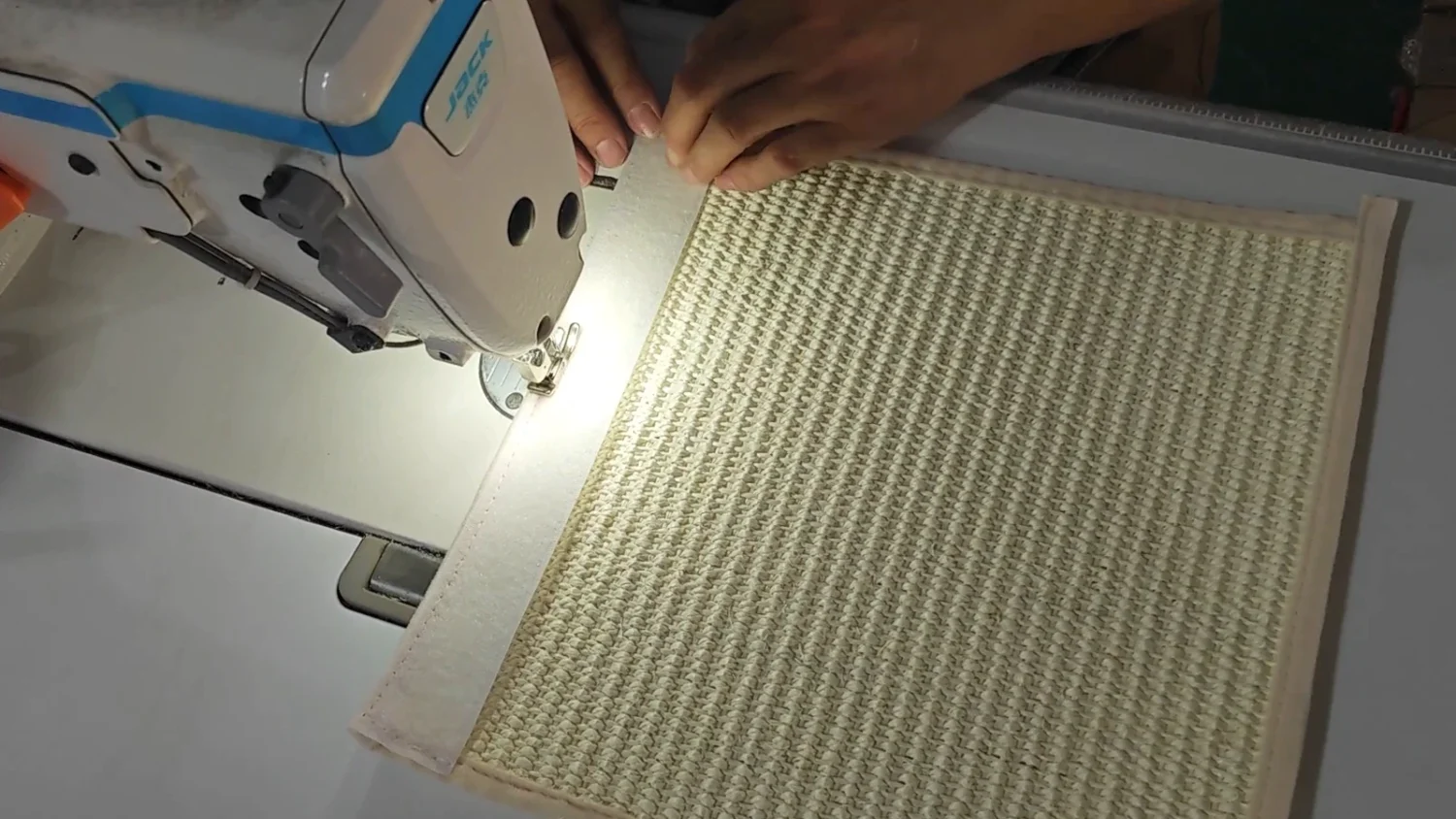
Featured image: edge stitching around a textured cat scratching mat, captured from HOMVND’s component-processing video.
1. Prepare Materials for the Named Components
The starting point is a defined product configuration. Bases, platforms, posts, houses, cushions and covers need their own material and component definitions. Do not assume that every board is MDF or particleboard, that every post has the same core, or that every condo is a rigid panel box.
Material preparation brings the selected boards, post cores, scratching coverings, textiles and hardware into the production route. Petstar’s published manufacturing account describes incoming-material inspection before board, textile and post processing. The relevant checks for a buyer depend on what is being supplied: board identity and thickness, post-core dimensions, covering reference, textile color and the selected connection system.
For the detailed fields behind those decisions, use the Cat Tree Materials and Component Specifications guide. Here, the focus is what happens to those parts during manufacturing.
2. Cut, Shape and Prepare the Board Parts
For board-based designs, sheet material is cut into bases, platforms, steps or house panels. Curved profiles and openings require shaping, while connection holes establish where posts and adjoining parts will meet. Petstar describes cutting, shaped machining, edge treatment and hole preparation in its own route.
Edge treatment follows the component design. An exposed finished edge and an edge that will be covered with textile are different specifications; edge banding should not be assumed for every upholstered part. Covering and hardware access also need to agree with the hole layout.
A platform-size change therefore calls for more than a new outside dimension. Buyers should review the support positions, openings, covering allowance and mating parts together. A sample assembled with the intended components can reveal a mismatch that a front-view rendering does not show.
There are other manufacturing routes. Cloud 9 describes shaped solid-wood tree structures and molded composite platforms, with different platform options for its all-wood designs. These examples show why a supplier’s actual component construction matters more than applying one board-processing sequence to every cat tree.
3. Process the Posts and Apply the Scratching Covering
A finished scratching post combines a core, end or connection details, and an outer surface. Petstar describes processing cardboard tubes and then wrapping them with sisal rope or fabric. That is a documented route for its products; other selected constructions require their own core and joining definitions.
Wrapping creates the finished outside surface. The buyer’s reference should show where the scratching coverage begins and ends, what remains exposed, and how the covering meets the post ends. Rope wrapping and a fabric or mat covering need different appearance references.
Distinguish the bare core from the finished post when discussing diameter. Also keep the end connection tied to the matching base or platform. A similar-looking post is not automatically interchangeable, and a thicker-looking post does not establish a load or durability rating.
4. Cut, Sew and Secure the Textile Parts
Fabric is cut into pieces for the selected shapes, then sewn or secured according to the component design. Petstar describes fabric cutting and sewing as separate operations. A fitted cover, a fabric-shell condo, a hammock and textile wrapped around a rigid platform have different construction needs.
Seams, folded edges and fixing positions become visible details of the finished part. They also affect access to openings and connectors. When changing a fabric or shape, review how the material sits around corners, how the underside is finished, and whether the intended assembly points remain accessible.
Use the sample to review these details on the actual component. The manufacturing method alone does not establish that a cover is removable or machine washable; any care claim needs confirmation for the named part and version.
HOMVND Component-Processing Video
HOMVND’s component-processing video shows three observable operations: equipment-assisted work on a wrapped cylindrical post, edge stitching around a textured mat, and fastening fabric around a rectangular panel edge. The stitching shown is textile edge stitching, not board edge banding. The film presents selected component operations rather than a complete factory walkthrough or a full production sequence.
Watch Cat Tree Component Processing on YouTube.
5. Bring Parts Together and Check Assembly
The separate routes converge when the boards, finished posts, soft parts and hardware are matched to one configuration. Petstar’s account includes hardware sorting and packaging. At this stage, component identification helps distinguish similar posts, left- and right-oriented parts, and hardware intended for different connections.
For a buyer’s assembly review, build a representative unit using the intended parts, hardware and instructions. Look at whether the posts seat against the correct surfaces, platforms face the intended direction, openings remain accessible, and the part counts match the configuration. Record a mismatch before assuming its cause.
The Cat Tree Product Development guide explains how the brief, sample and approved version are established. The Cat Tree Quality Control guide covers inspection planning and deviations. An assembly check connects the processed parts; product-specific performance claims require their own applicable evidence.
6. Organize Protection and Pack the Sales Unit
In a flat-pack program, the processed components become a packed set for later assembly. Petstar describes inspection followed by cartoning. The packing arrangement needs to account for the actual parts: long posts and their ends, board edges and projections, scratching and textile surfaces, hardware bags, and instructions.
For the selected package, review which surfaces touch, where parts can move, and whether hardware is separated from visible coverings. Confirm the contents and arrangement of the complete sales unit, including any multi-carton configuration. These are package-specific review points, not a universal protection recipe.
A packing sample should therefore be reviewed alongside the assembled sample. Changes to post length, platform shape or soft-part construction can require another look at how the set fits in the carton. Any claim about freight savings, damage prevention or packaging-test performance needs evidence for the applicable packed version.
Discuss a Cat Tree Manufacturing Brief with HOMVND
HOMVND supports bulk supply and OEM/ODM cat tree projects for importers, wholesalers, e-commerce sellers and private-label brands, working with cooperating factories on project requirements. Start with a model or reference design, intended structure, target market, quantity by model, and the changes you want to discuss. Add material, covering, assembly or packaging requirements where known.
Cat Tree orders usually start from 100 units. The specific models, configurations and quantity allocation are confirmed in the project quotation. Review the Cat Tree Collection for current product directions.
Manufacturing References
The industry examples draw on Petstar’s published cat tree manufacturing process and Cloud 9’s explanation of how its trees are made, reviewed on November 11, 2026. Each describes its own construction route. Their equipment, operating parameters, certifications and performance claims are not presented as HOMVND facts.