
Planning a Furniture Pilot Order Before a Larger Purchase
Agree the purpose, product scope, quantities, costs and delivery conditions of a furniture pilot order, then use defined observations to decide the next purchase.
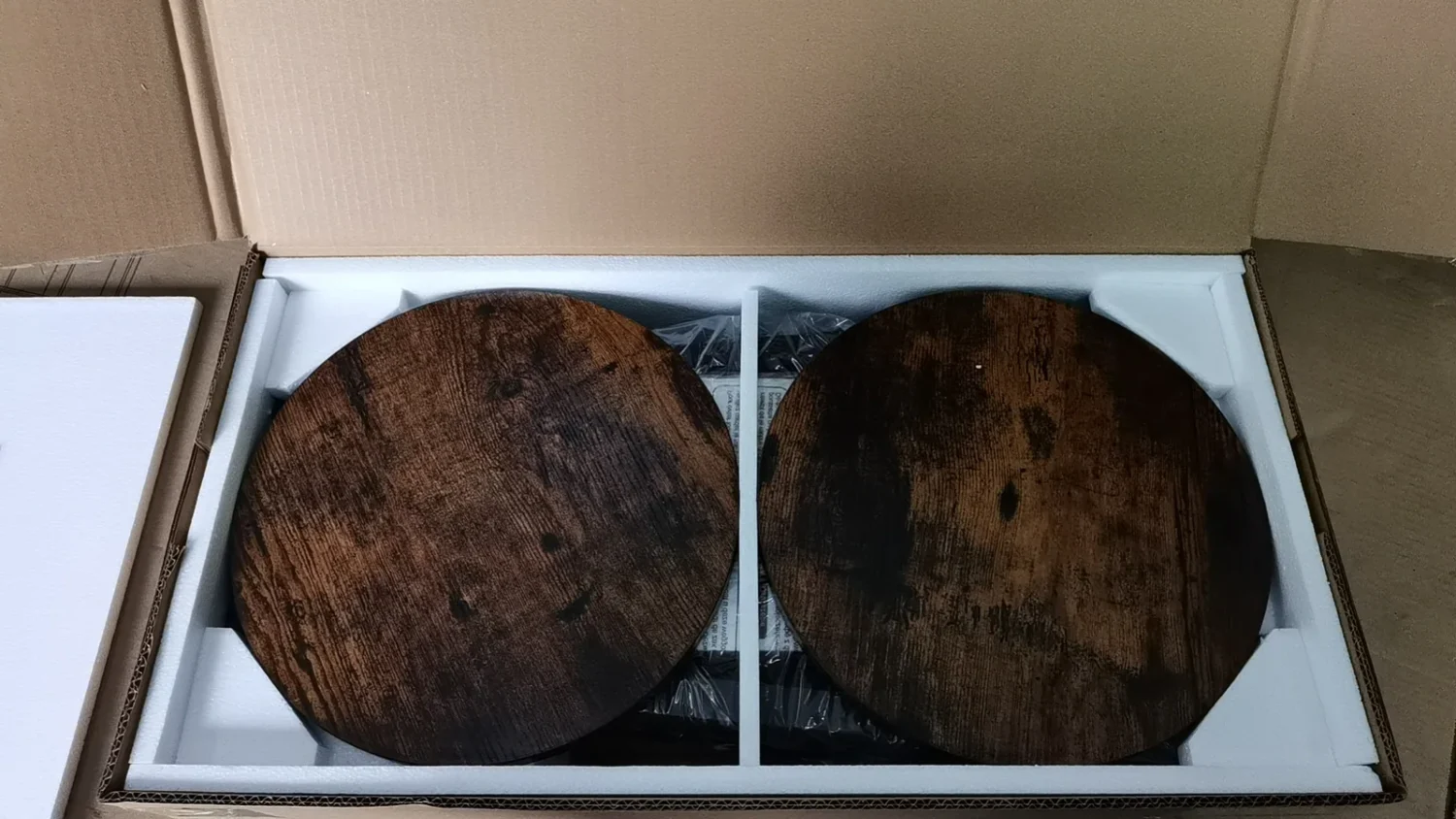
Packaging reference: an open furniture carton showing two round panels, foam perimeter and divider protection, and wrapped components. This photo shows a packing arrangement, not a pilot-order outcome or test result.
A furniture pilot order is most useful when the buyer and supplier agree what decision it is intended to support. Before committing to a larger purchase, define the products, versions, quantities, commercial terms and observations that will make the first order informative.
For importers, private-label brands and marketplace sellers, the practical task is to turn a request for a limited order into an accepted purchasing scope. Keep the requested quantities and conditions separate from what the supplier has confirmed.
Should You Keep Buying Locally or Test Direct Import?
This comparison is for furniture retailers already replenishing a product through a local wholesaler and holding sales records for that SKU.
| What to compare | Local wholesale | Direct import pilot |
|---|---|---|
| Sales and stock coverage | Divide the proposed reorder quantity by actual monthly unit sales to estimate months of stock, then repeat with lower sales. | Apply the same calculation to the proposed pilot quantity. If branding or specifications change, use the existing SKU’s sales only as a reference. |
| Cost to the same destination warehouse | Confirm the specification, quantity and delivery location, including which freight and handling charges the quotation covers. | Compare on the same basis. Separate per-unit costs from one-time charges, include applicable costs through warehouse receipt, and count each freight charge once. |
| Cash tied up | Map payment dates, expected receipt and sales receipts to estimate how much cash you must advance and for how long. | Map the pilot’s payment milestones, expected arrival and sales receipts to estimate the first batch’s funding requirement and cash recovery period. |
| Replenishment and slow sales | Check available replenishment options if deliveries slip and how much stock you can carry if sales slow. | Check how you would replenish during a delay and whether you can fund and store the remaining pilot stock if sales slow. |
| Additional responsibilities | Confirm who approves specifications and packaging, handles quality issues, and pays applicable delivery and after-sales costs. | Confirm who approves specifications and packaging, handles quality issues, takes responsibility for import steps, and pays import and after-sales costs. |
If sales or funding conditions remain uncertain, continuing local replenishment may be appropriate.
When you are ready to consider a pilot, send HOMVND the product specifications, expected quantities and destination warehouse to check MOQ, packaging requirements and quotation terms.
Start with the Decision the Pilot Should Support
Separate three purposes, even if the project includes more than one:
- Product sample confirmation: review identified attributes such as appearance, dimensions or assembly against agreed references.
- Production execution observation: examine how the agreed product and packaging requirements are carried through the identified batch, within an agreed inspection scope.
- Actual sales observation: gather feedback from the intended market after saleable units reach customers under the planned offer and delivery conditions.
Name the next decision before ordering: whether to accept a product reference, proceed with a larger purchase, revise the pack-out or narrow the range. Agree who will collect the relevant records and who will review them, at what point.
One pilot does not establish all-product quality or market demand. A reviewed sample, an inspected batch and customer sales observations answer different questions. The guide to approved samples and mass-production conformity explains the sample boundary in more detail.
Keep the Product and Version Scope Understandable
Identify each SKU and product revision, including its size or configuration, color or finish, hardware reference, packaging version and instruction-manual version. Where labels or artwork are part of the order, identify their current references too. Record what is approved, what is proposed and what still needs a decision before release.
Keep the range small enough to interpret. Changing the product structure, finish, packaging and sales offer at the same time makes it harder to identify which condition relates to an observed problem or response. If several variants are necessary, keep observations tied to the actual variant and version rather than combining them into one undifferentiated result.
Agree Quantities, Costs and Delivery Conditions
State the total order quantity, quantity per SKU and allocation by color or finish. Check that the allocations add up to the total. Ask how MOQ applies to the proposed mix: across the order, by model, by finish or under another specifically quoted basis. Confirm whether the requested split is feasible and record the accepted allocation.
Calling an order a pilot does not mean the supplier accepts quantities below MOQ or mixed models and colors. Obtain project-specific confirmation before treating the request as an order commitment.
Separate the unit quotation from sample charges and any one-time development, tooling, artwork or packaging-preparation charges that apply. Confirm currency, payment terms, quote validity, included work and exclusions. If any charge could be credited against a later order, record the quoted conditions rather than assuming a credit.
Define delivery scope: destination or named handover point, the agreed trade term where used, transport responsibilities, carton identification and any requirement to receive complete product sets. Identify the packaging and document references to be delivered with the goods. Do not leave freight, import handling or final delivery implicitly included in an undefined price. For a pilot shipped by sea, use the LCL and FCL cost comparison to compare the same cargo through delivery to your warehouse.
Distinguish preparation, production, dispatch and transit estimates. Record the agreed conditions that start each timing commitment, such as payment receipt, final specification approval or artwork release, and how unresolved items affect the schedule. Ask whether the later larger order will need a fresh quotation; pilot pricing and timing should not be carried forward without confirmation.
Put the Pilot Agreement in One Reviewable Record
Use the following checklist to align the order confirmation and supporting references. Keep the supplier-confirmed scope, open items and responsible people visible alongside the record.
On smaller screens, scroll the table horizontally to see the final column.
| Decision area | Agree before ordering | Record for the next decision |
|---|---|---|
| Purpose | Sample, production or sales question; review point; decision owner. | Evidence reviewed; question answered; remaining uncertainty. |
| Product version | SKU, configuration, finish and current product references. | Version received; departures from the agreed reference. |
| Quantity and colors | Total, per-SKU and finish split; accepted MOQ basis. | Actual allocation received; proposed next-order mix. |
| Packaging and delivery | Pack-out, manual, labels, destination and delivery responsibilities. | Receipt condition, completeness and assembly observations. |
| Costs and timing | Unit and one-time charges; payment; timing triggers; requote basis. | Actual charges and dates; conditions requiring a new quote. |
| Observations and next step | Records to collect; review owner and date; decision criteria. | Continue, adjust, narrow or pause; actions and approvals needed. |
Review the Evidence Before Increasing the Purchase
Compare the observations with the questions agreed at the start. Keep transport and receipt issues separate from assembly findings, customer feedback and sales performance. For a damaged component, retain the product and packaging version, receipt photos and delivery context. For an assembly issue, identify the affected part, hardware and manual reference. Record customer comments as feedback, including which variant they concern.
Sales results need their commercial context: the offer, price, availability, exposure and observation period. A change in sales alone does not show that a particular finish, feature or packaging change caused it.
The next decision may be to continue with the agreed scope, adjust the product or packaging, narrow the SKU or color range, or pause while an unresolved issue is investigated. State what evidence supports that choice and what remains uncertain. Do not expand the order simply because the first batch has been delivered.
If the next order changes dimensions, finish, hardware or packaging, identify the affected specifications, drawings, parts lists, manuals and sample references for review through furniture product revision control. Separately reconfirm quantities, MOQ basis, price, charges, payment, delivery scope and timing when the purchasing conditions change. Earlier approval or a quotation may cover only the earlier scope.
What to Send with a Pilot-Order Inquiry
- The decision you want the pilot to support and the intended market or channel.
- The product shortlist, configurations, finishes and current specification or sample references.
- The requested total, per-SKU quantities and color allocation.
- The packaging, labeling, manual and delivery requirements, including destination and target timing.
- The observations you plan to collect, review responsibility and open questions for quotation.
Use the furniture product specification sheet guide to organize the product references, then share the proposed pilot scope with HOMVND for a project discussion. The next step is to confirm feasibility and quotation conditions for that scope before placing the order.