
One Carton or Two? A Packaging Decision Guide for Furniture Buyers
Compare one-carton and two-carton proposals for the same furniture sales unit. Check packed data, protection, complete-set delivery, cost scope and approval evidence before deciding.
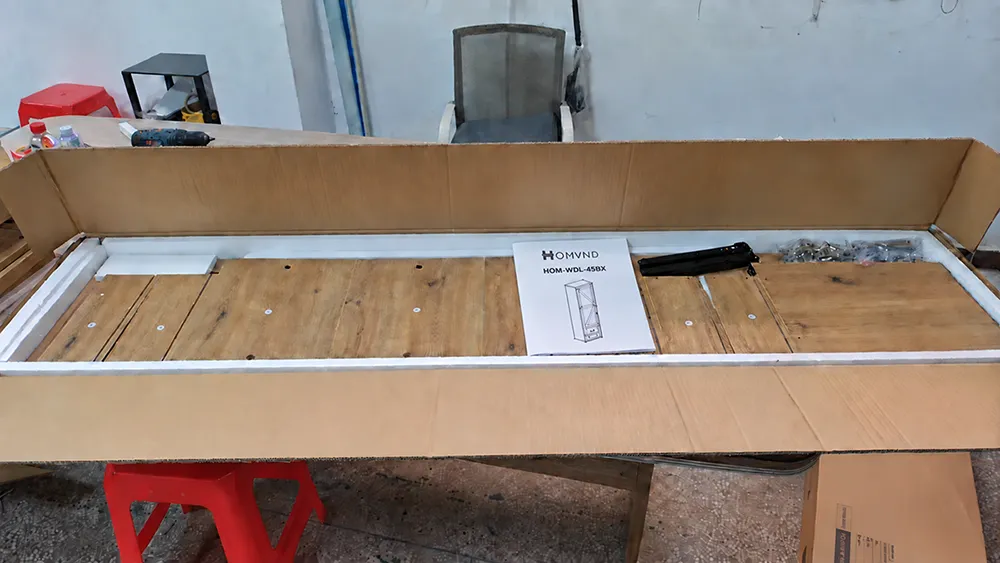
Packaging reference: an open carton for a tall storage cabinet with a hinged door and two lower drawers. Visible panels, perimeter foam, bagged hardware and an instruction booklet illustrate this pack-out only. The photo does not compare carton counts or establish a transport-test result.
One carton or two is not, by itself, evidence that a furniture packaging proposal is cheaper, safer or better suited to ecommerce. Compare the same product version, number of complete sales units, destination and delivery requirements. Then assess the proposed packages and the records supporting them.
For importers, private-label brands and online sellers, the decision concerns delivery of a complete product. A lower weight for one carton does not answer whether the whole set can be received, stored, dispatched and returned under the intended operating conditions.
Start with the Reason for Changing Carton Count
Define the problem before asking for a different number of boxes. Is the concern a packed dimension, gross weight, component protection, handling arrangement or a requirement from the intended sales channel? Record which condition is confirmed and which is an objective still to be assessed.
A request to split a heavy package and a concern about keeping cartons together in a warehouse can both matter. Neither settles the decision alone. Ask whether a revised one-carton pack-out, a two-carton proposal or further product development should be investigated; do not assume that any option is already available for the selected model.
Define Both Proposals on the Same Basis
Identify the product, configuration and revision represented by each proposal. Use the same order quantity, destination, fulfillment route and delivery expectation. If an option requires a product revision, identify that change explicitly and review its implications before treating the offers as equivalent.
For every carton, request its contents, sealed external dimensions, gross weight, carton identity and packaging revision. Separately record how many cartons make one complete sales unit. Distinguish measured packed-sample data from drawing values, estimates or targets; an unmeasured figure remains to be verified.
For a two-carton proposal, identify both cartons and the components assigned to each. Adding the dimensions of two cartons does not describe a single parcel. Keep each carton’s dimensions and gross weight visible, while identifying which costs and operational checks apply to the complete set. The furniture product specification provides the upstream product reference.
Compare One-Carton and Two-Carton Proposals
Use the following as a decision framework, not a statement that either configuration has passed review. An unanswered item should remain open rather than being filled with an assumed advantage.
| Review area | One-carton proposal: check | Two-carton proposal: check | Decision evidence |
|---|---|---|---|
| Size, weight and acceptance | Sealed external dimensions and gross weight. | Sealed external dimensions and gross weight of each carton. | Measured data; current market, service and route acceptance requirements. |
| Components and protection | Contents, layout and protection. | Component allocation, protection and affected interfaces. | Pack-out references; required configuration-specific validation. |
| Complete-set delivery | Complete contents and product identifier. | Linked carton numbers; set identification at receipt and dispatch. | Contents list; agreed warehouse and delivery handling. |
| Cost scope | Packaging, transport, storage and fulfillment for one complete product. | Both cartons plus applicable set-handling charges. | Comparable itemized quotes, assumptions, exclusions and validity. |
| Exceptions and returns | Missing contents, damage and return collection. | Staggered arrival, missing carton, partial and complete returns. | Agreed exception handling and responsibilities. |
| Approval records | Sample reference and approved attributes. | Both carton references, their linkage and affected product documents. | Approval scope, evidence and conditions. |
Count the Cost of Delivering a Complete Set
Compare the scope of the quotations before comparing their totals. Confirm whether each covers the same number of complete products, packaging preparation, transport legs, destination handling, storage and order fulfillment. Identify exclusions and the party responsible for costs that have not been quoted.
A freight figure for only one of two cartons is not a complete-set comparison. Nor does a quoted transport price establish that a warehouse or fulfillment program will accept the proposed arrangement. Check the operating conditions separately, including receipt, identification, dispatch and the agreed response when only part of a set arrives.
For the separate relationship between packed measurements and cost exposure, see carton size, weight and marketplace fulfillment costs.
Approve a Proposal, Request Changes or Keep It Open
Retain the one-carton proposal when its identified configuration satisfies the agreed product, protection, handling and delivery requirements and the complete-set quotation is acceptable.
Consider the two-carton proposal when the allocation, packed data, required verification and complete-set operating arrangements are defined and accepted. A split that addresses one concern should also be reviewed against the other decision criteria, rather than being approved on weight alone.
Keep the decision open when a decisive input is missing: unverified packed measurements, an undefined component split, unresolved protection evidence, unclear warehouse acceptance or an incomplete quotation. Record the missing input, who will provide it and which decision it affects. A proposal with open conditions should not be presented as an approved packaging specification.
If the option changes the product or its references, follow the existing furniture revision-control process. Package approval applies to the identified configuration and agreed scope; it does not guarantee shipment outcomes or conformity of every production unit.
What to Request from the Supplier
- The product and revision covered by each proposal, the reason for the change and any product changes required.
- Each carton’s contents, identity, sealed dimensions, gross weight and packaging revision, with measured and provisional data distinguished.
- The pack-out reference, applicable verification evidence and proposed method for identifying and handling a complete set.
- Comparable quotations and documented assumptions for packaging, transport, storage, fulfillment and exception handling.
- The approval scope, decision owner, open conditions and records that would change if the option is accepted.
Use the agreed decision to complete the furniture packaging requirements. This is the handoff from choosing an option to recording the approved configuration.