
How Furniture Product Revisions Move from Buyer Brief to Production Reference
A furniture revision rarely belongs to one drawing alone. When a private-label buyer changes a dimension, component or function, that decision can affect the specification, BOM, joining interfaces, hardware quantities, assembly sequence, manual, sample record and packaging reference. Revision control is the work of finding those dependencies and keeping the applicable records aligned.
Direct answer
Turn a buyer request into a controlled product revision by identifying the starting model and revision, defining the requested outcome, and recording the parts and open decisions affected. Update the drawing and specification first, then review the BOM, hardware, joining interfaces, assembly instructions, packaging and sample records against that same revision. An approved sample or packed sample can anchor a defined reference, but it does not automatically update other documents or guarantee mass-production conformity.
1. Turn the Buyer Brief into a Controlled Change Request
A buyer brief often begins in practical language: make the unit narrower, change the storage arrangement, split a large component, add a removable part or adapt the product to a channel constraint. The first control step is to translate that request into a change record that engineering, sourcing, packaging and QC can interpret consistently.
Identify the product or SKU, the starting revision and the requested outcome. Record what must remain fixed, what may change and which decisions are still open. “Make it smaller” is not sufficient if it leaves height, depth, usable space, hardware, stability considerations and packaging consequences undefined. A controlled request turns the phrase into specific fields for review without assuming the solution in advance.
Separate buyer requirements from proposed engineering responses. A buyer may require a maximum width or removable tray; the supplier may propose revised dimensions, components and interfaces. This preserves the reason for the revision.
The sequence in this article is practical buyer-recommended guidance, not a universal fixed HOMVND workflow. The exact document set, roles and approval sequence depend on the product and project.
2. Freeze the Starting Reference Before Revising It
Revision work needs a baseline. Before changing the product, identify the current drawing or specification, BOM, hardware list, manual, sample status and packaging record that represent the starting state. If several versions are circulating, mark which is approved, which is a working draft and which is superseded.
The baseline should capture the fields relevant to the proposed change. For a dimensional revision, that may include overall and component dimensions, hole locations, clearances and packaging identity. For a structural revision, include part configuration, interfaces, hardware and assembly sequence. The purpose is not to archive every historical detail inside one document; it is to make the before-and-after comparison unambiguous.
Sample identity belongs in the baseline as well. A room photo, prototype, finish board and packed sample can each support different decisions. State the model, revision and scope represented by the reference rather than treating “the approved sample” as a universal object.
A frozen baseline also exposes an older manual or hardware list as superseded rather than current.
3. Revise the Drawing and Product Specification
The revised drawing or specification should show the intended product state, not only the headline dimension. Review affected parts, interfaces, component identifiers, orientation, clearances and functional relationships. A change that appears local may create downstream questions that need explicit decisions.
Give the working revision a clear identifier and date. Record the reason for change, responsible decision owners where the project requires them, and any unresolved items. If a proposed dimension remains provisional pending sample review, label it accordingly rather than presenting it as approved.
REAL HOMVND EXAMPLE — supporting buyer-brief evidence
Furniture Evidence Case 03 records an anonymous buyer request for a narrower rolling cart with a removable tray. The resulting controlled engineering revision specified a 43 cm width and a removable tray measuring 39.8 × 30 × 8 cm, with adjusted frame proportions. This evidence demonstrates brief-to-engineering translation for one project. It does not prove final sample approval or mass production.
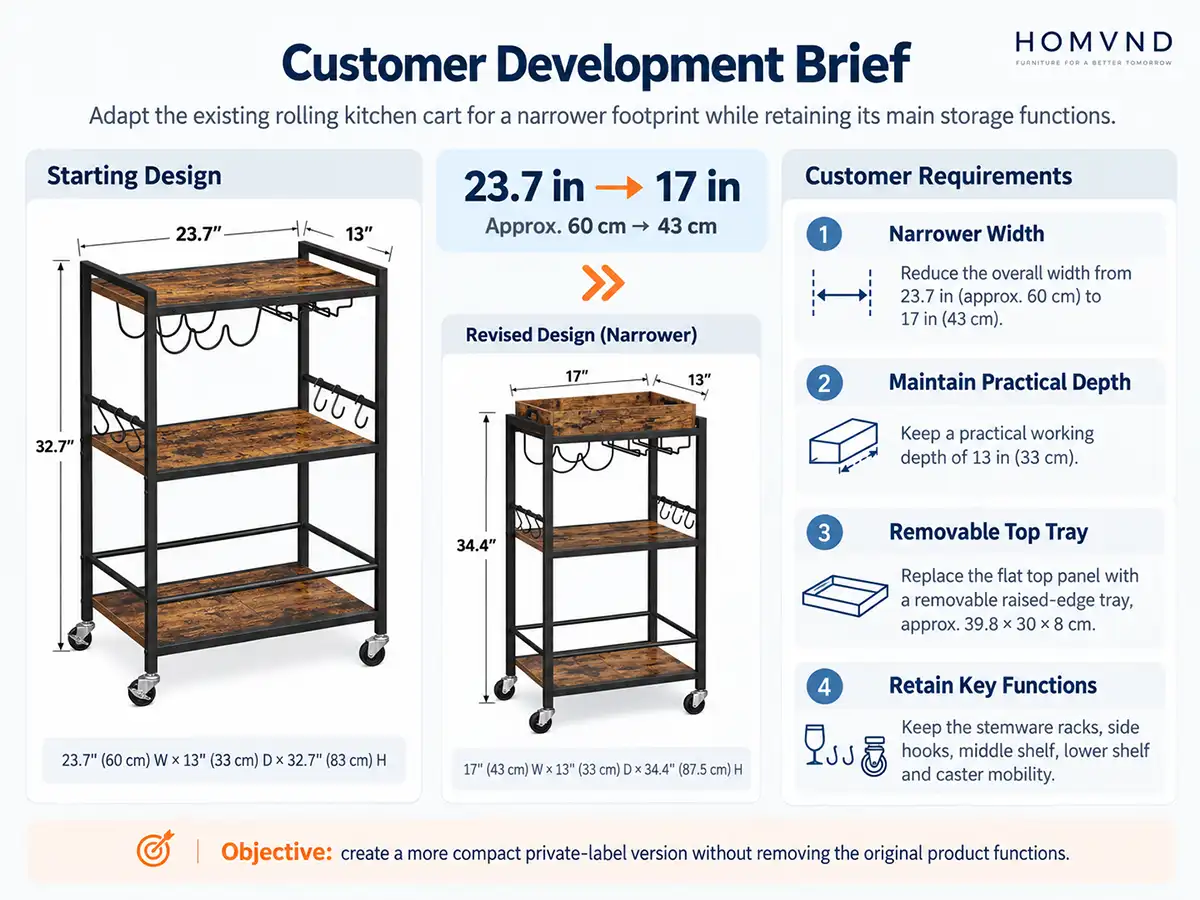
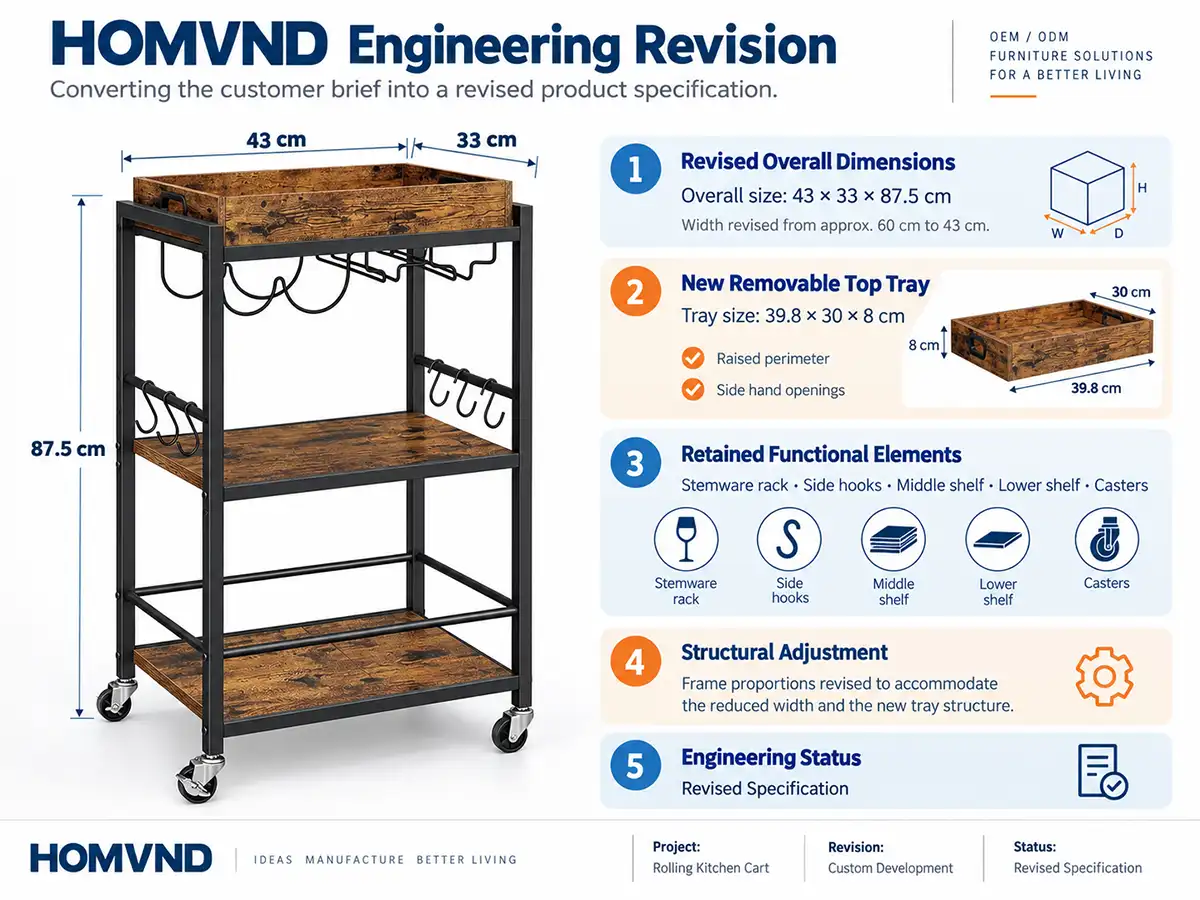
The example shows how a broad request became a reviewable engineering state; it does not establish a universal sequence or document format.
4. Trace the Change into BOM, Hardware and Joining Interfaces
A revised drawing does not automatically update the BOM. Compare the new structure with the baseline and identify added, removed, replaced or quantity-changed parts. Confirm that the BOM and part identifiers describe the same configuration shown in the drawing.
Hardware requires more than a generic name. Review identity, quantity, position, mating components and the interface it serves. Where applicable, check hole preparation, insert or fastener relationship, edge distance, orientation and access during assembly. These details are product-, substrate- and system-specific; this guide does not prescribe universal drilling or torque values.
The review should answer practical questions:
- Does a split or added component require a new connector or different quantity?
- Do both mating parts show the corresponding interface?
- Does the hardware list use the same part code as the BOM and manual?
- Has any removed connector also been removed from the packed set and instructions?
- Does the revised geometry still allow the intended assembly action?
The outcome may be “no hardware change,” but that should be a reviewed conclusion. Otherwise, the old hardware list can remain attached to a new structure simply because no one owned the dependency.
5. Update Assembly Sequence and Instructions
Assembly instructions are part of the product definition for flat-pack furniture. When structure or hardware changes, review part identification, orientation, sequence and the relationship between diagrams and the current packed components.
The revised manual should use the same part codes and hardware identities as the current BOM. Diagrams should show the correct component configuration and connector positions. If a structural change creates a new intermediate assembly step or changes access to a fastener, the sequence may also need revision.
Trial assembly can provide useful evidence that the included parts, hardware and instructions correspond to the reviewed version. Its scope should be stated, and this example does not imply trial assembly for every batch. A successful assembly of a defined sample does not establish a universal reassembly claim, load rating, durability result or mass-production guarantee.
Because old PDFs and printed inserts can persist, the release record should identify the applicable manual and superseded editions.
6. Review Packaging as Part of the Same Revision Chain
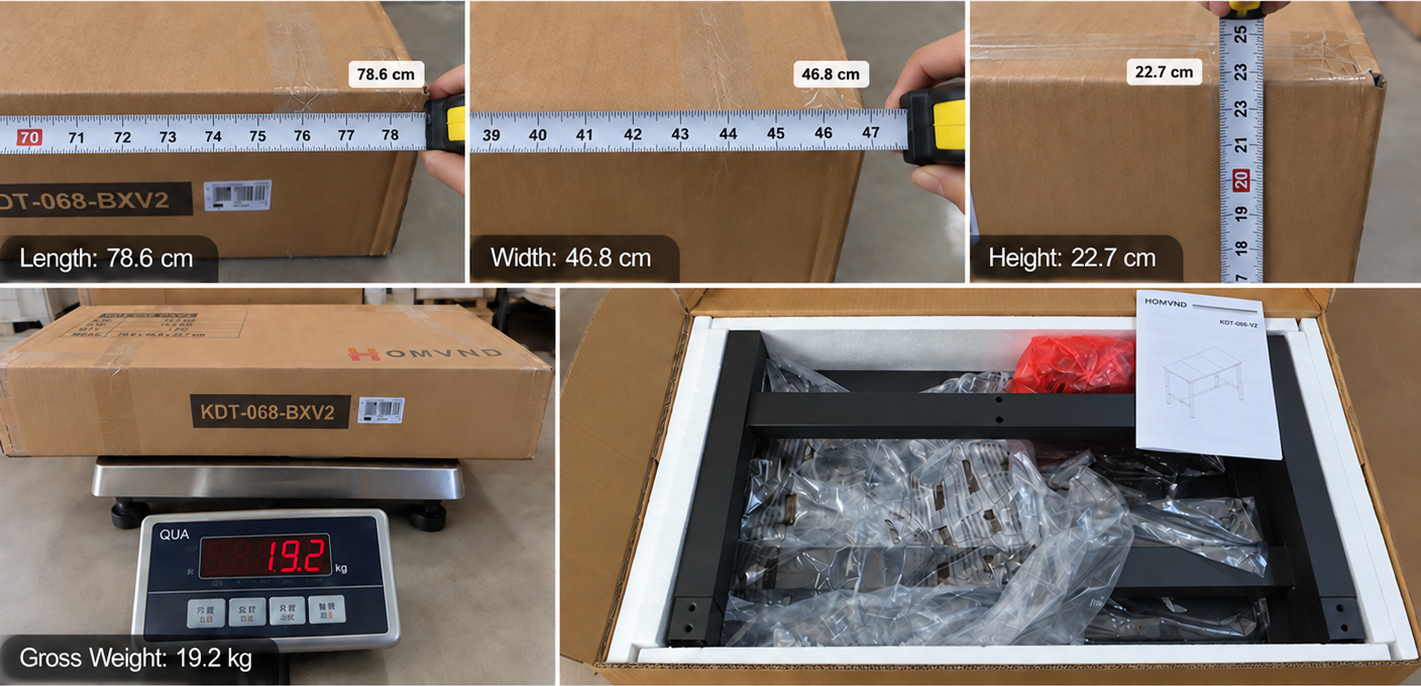
As buyer guidance, product and packaging revisions may use separate identifiers, but their applicability should be explicitly related. This does not imply a universal HOMVND identifier system. A change in component size, part count or configuration may affect carton layout, dimensions, gross weight, protection, labels, contents and the identity of the manual or hardware pack inside. Whether any field actually changes must be reviewed for the specific product.
The packaging record should identify the applicable product state. If a packed sample is used, record which product revision and packaging revision it represents. A closed carton alone may confirm external identity and dimensions within its evidence scope; an open-carton record may support the arrangement and contents visible in that record. Neither automatically proves transport performance or later shipment conformity.
Avoid treating packaging revision as a guaranteed savings mechanism. A redesign may change one or more carton dimensions without reducing total packed volume. It may also increase thickness while reducing the longest side. Freight, marketplace, warehouse, damage and return outcomes require their own current, route- and program-specific evidence.
For revision control, the essential question is simpler: does the packaging specification correspond to the approved product configuration, parts, manual and hardware set?
7. Use Sample Review to Close Decisions, Not Guarantee Production
Sample review should compare the identified sample with the applicable drawing and specification. Confirm model and revision before reviewing dimensions, function, parts, hardware, assembly, appearance or packaging fields that fall within the sample's purpose.
Record decisions rather than only comments. Separate approved differences, items requiring correction, unresolved deviations and fields outside the review scope. If a sample-driven decision changes the intended product, update the relevant drawing, specification, BOM or manual instead of leaving the approval only in an email or chat thread.
An approved sample is a reference, not an automatic update mechanism. It does not prove that the BOM, packaging record or instructions have already been revised. It also does not by itself prove mass-production consistency, applicable test results or compliance. Those conclusions require evidence matched to the product, revision and stated scope.
The same boundary applies to a packed sample. It can represent a defined product plus packaging revision. It does not guarantee shipment performance, warehouse acceptance or the condition of every production unit.
8. Close a Version-Aligned Production Reference
In this article, version-aligned production reference is descriptive terminology for an applicable set of records that describes one intended state and keeps open decisions visible; it is not presented as an official HOMVND internal term. Depending on the project, the aligned set may include:
- current drawing and product specification;
- current BOM and hardware list;
- applicable finish or component references;
- current assembly instructions;
- packaging specification and packed-sample identity;
- sample approval and deviation record;
- applicable test or compliance documents, where required.
Not every project needs the same documents. What matters is that the set used for release is complete for the defined product and that each record points to the correct revision. The release record should identify superseded documents and the triggers that would require a new review.
QC can then compare production observations with the approved requirement and current reference. That does not turn revision control into a full inspection plan; it ensures that inspection is not performed against an obsolete drawing, manual or sample.
Revision closure should preserve traceability so a future change starts from the approved state, not an unlabeled file assumed to be current.
9. What Real HOMVND Revision Evidence Shows
| Product state | Documented structure |
|---|---|
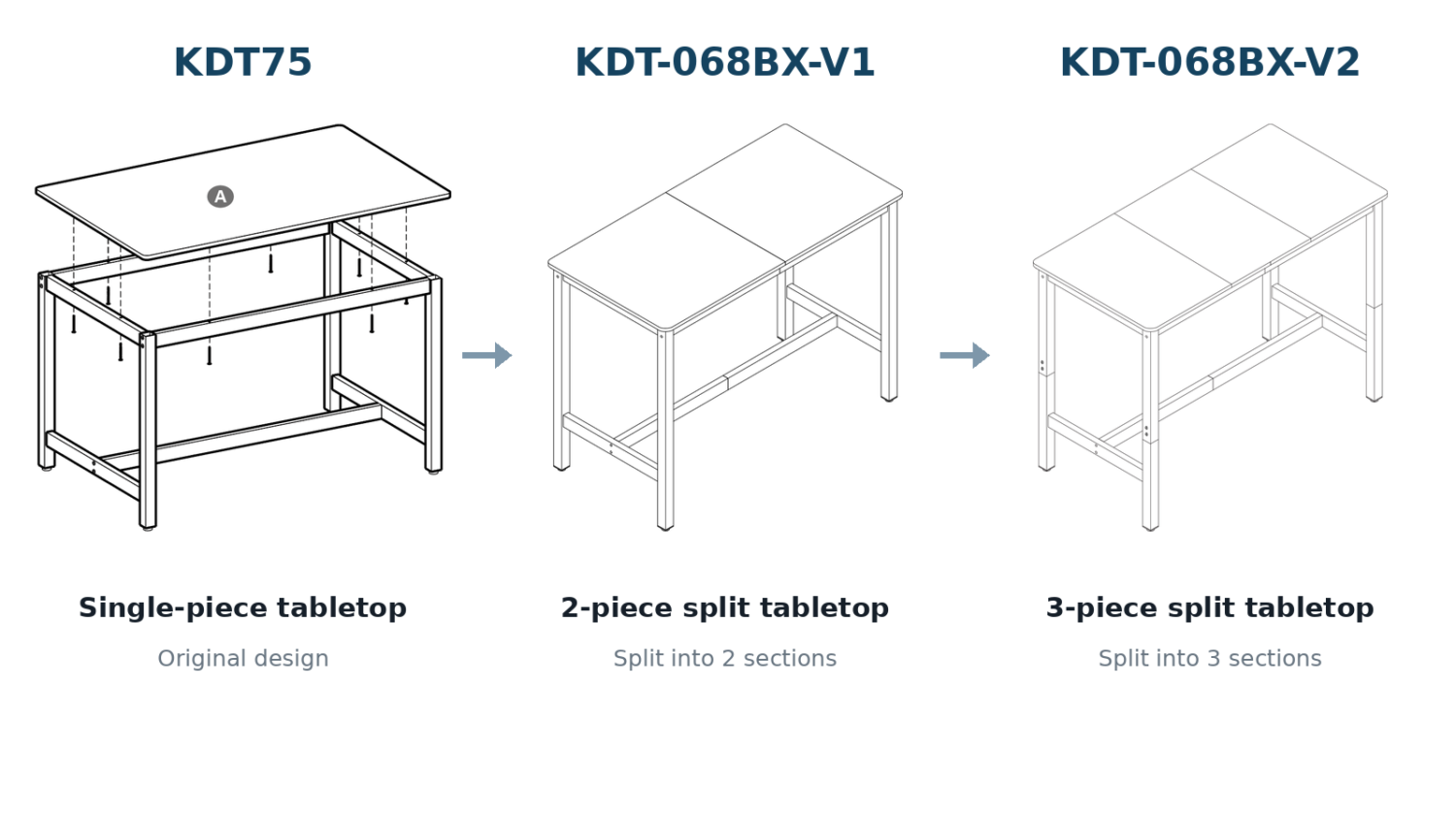
| KDT75 | Single-panel configuration |
| KDT-068BX-V1 | Two-part configuration |
| KDT-068BX-V2 | Three-part configuration |
REAL HOMVND EXAMPLE — primary revision-chain evidence
Furniture Evidence Case 01 records one Owner-confirmed lifecycle:
KDT75 → KDT-068BX-V1 → KDT-068BX-V2. The structure moved from a single-panel configuration to two-part and then three-part configurations. Joining hardware and assembly instructions changed with those structural revisions, and packaging specifications changed across the same named lifecycle.
The case demonstrates that one real structural revision can propagate beyond the drawing. It connects part configuration, hardware, assembly and packaging to version control. Current KDT-068BX-V2 packaging also has approved real-photo and physical-measurement evidence. The full Case 01 evidence module remains owned by the Furniture Sourcing Guide; this article uses the lifecycle only to explain the revision chain.
Case 01 does not retain the original buyer brief, so it cannot prove a complete buyer-brief-to-production workflow. Case 03 supplies a narrower supporting example of an anonymous buyer request translated into a controlled engineering revision. Case 03 stops before final sample approval and mass production.
Neither case proves that every HOMVND project follows an identical workflow, that sample approval guarantees conformity, or that a revision automatically improves cost, quality, freight, damage, returns or lead time. The evidence supports a more disciplined conclusion: dependent records should be reviewed and aligned whenever the product state changes.
Frequently Asked Questions
Does a drawing revision automatically update the BOM and manual?
No. The drawing establishes a revised product state, but affected BOM items, hardware, interfaces, part codes, assembly instructions and packaging records still require explicit review. Each applicable document should identify the same current revision or a clearly linked packaging/manual revision.
Is packaging a separate revision from the product?
It may have its own revision identifier. The critical point is that the packaging specification and any packed sample identify the product state they apply to. A product change should trigger a packaging review, but it does not mean every packaging field must change.
Does sample approval prove mass-production conformity?
No. It anchors agreed attributes for an identified product and revision within the sample's scope. Production documents and applicable QC evidence still need to match that state. Testing and compliance conclusions require their own current, applicable evidence.