
Powder Coating vs Wet Paint for Metal Furniture: What Buyers Should Specify and Approve
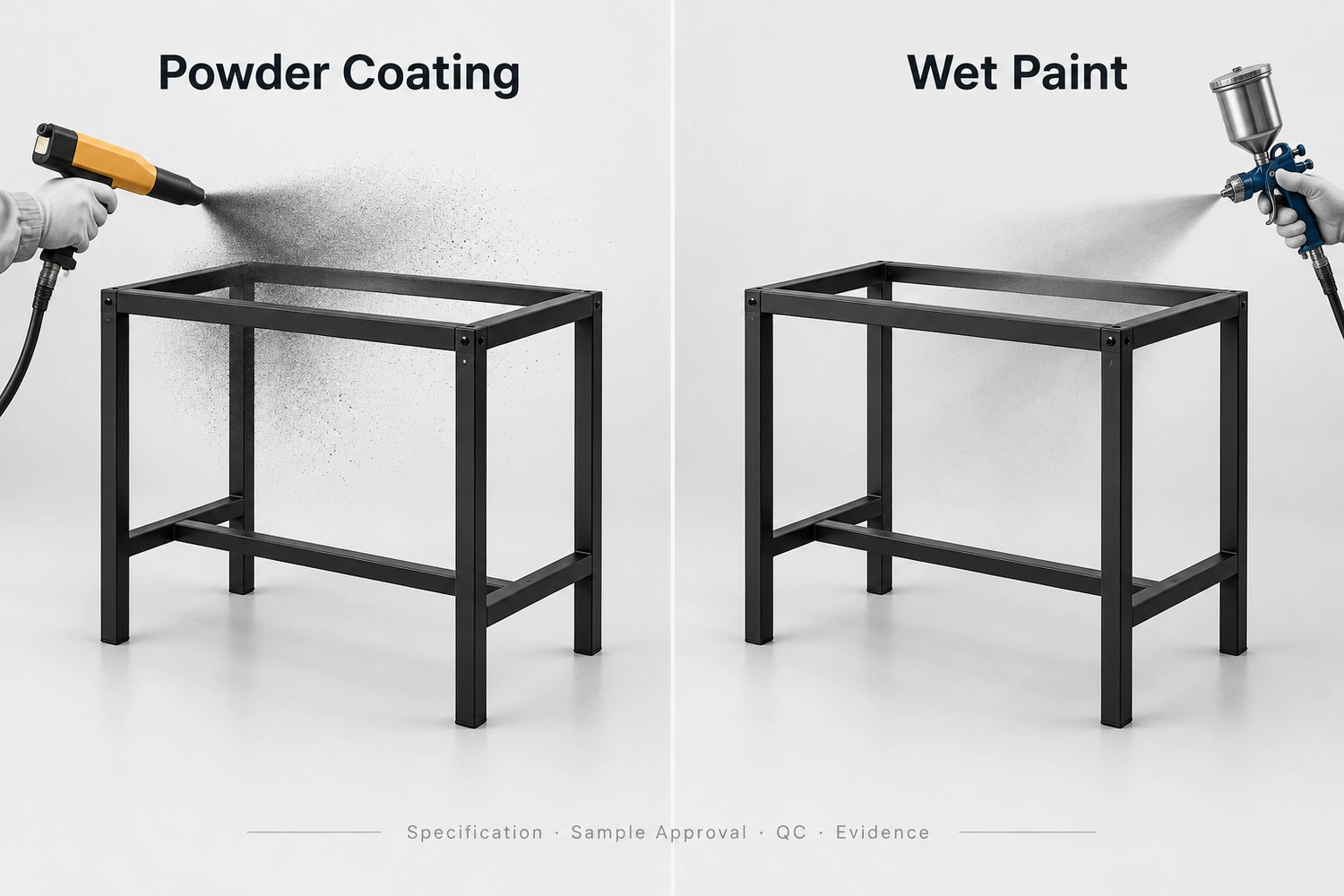
For a metal furniture program, “powder coated” or “wet painted” is not a complete finish specification. Either description may identify a broad process family, but it does not define the substrate, preparation, coating system, appearance target, acceptance criteria, or evidence needed for the actual product.
That distinction matters to importers, private-label brands, ecommerce sellers, and sourcing teams. A finish decision becomes manageable when it is translated into controlled requirements and an approval trail.
Direct answer
There is no universal winner between powder coating and wet paint for metal furniture. Buyers should choose and approve the finish for the specific product program, component, substrate, geometry, and appearance requirement. The RFQ should identify the preparation and coating system, color or physical reference, visible surfaces, approved sample, inspection criteria, and any applicable test or document requirement. A process name alone does not establish durability, cost, sustainability, appearance, or production consistency; those conclusions need product-specific requirements and relevant evidence.
Powder Coating and Wet Paint: What Buyers Are Actually Choosing
Powder coating applies charged dry particles to a grounded, conductive part and then uses thermal fusion and cure to form the coating. Wet coating, often called wet paint or liquid coating, is applied as a wet film and becomes solid through evaporation and/or crosslinking. The actual drying or curing route depends on the named coating system.
These descriptions explain the basic process difference. They do not determine which option is more durable, less expensive, more sustainable, or better-looking for every furniture product. They also do not define a production-ready specification.
At buyer level, the choice is between two proposed finish systems for identified components. The useful question is therefore: Which system, specification, reference, and control plan meet this product program’s requirements?
| Buyer decision area | Powder coating | Wet paint | What the buyer should confirm |
|---|---|---|---|
| Process identity | Dry particles applied to a grounded conductive part, followed by thermal fusion/cure | Wet film that becomes solid through the route defined by the coating system | The actual coating system and the components to which it applies |
| Appearance | Must be defined by an agreed reference and criteria | Must be defined by an agreed reference and criteria | Color, gloss or sheen, texture, visible scope, and acceptable variation |
| Sample approval | A labeled sample can establish an agreed reference | A labeled sample can establish an agreed reference | Sample identity, revision, substrate, preparation, and approval status |
| Production control | Process name alone does not prove conformity | Process name alone does not prove conformity | Inspection points, records, acceptance criteria, and change control |
| Performance claims | Require scoped evidence for the actual claim | Require scoped evidence for the actual claim | Product, sample, method, conditions, market, and report applicability |
Start With the Product and Component, Not the Finish Name
A furniture item may contain metal parts with different geometries, joining details, visibility, and handling exposure. Identify which parts receive the finish and which surfaces are visible after assembly. “Black powder coating” alone leaves open whether hidden faces, edges, weld areas, fastener interfaces, or touch-up locations share the requirement.
Start by documenting:
- the product, revision, and component names;
- the metal substrate or component identity;
- the surfaces included and any agreed exclusions;
- geometry or access areas that need explicit review;
- visible surfaces and appearance priority areas;
- assembly, handling, and packaging interfaces relevant to finish condition;
- the physical sample, color standard, or other controlled appearance reference.
This component-first approach also prevents a finish name from carrying claims it cannot support. “Powder coated” does not by itself prove a specific service life. “Wet painted” does not by itself prove a particular appearance level. The product requirement and its evidence must do that work.
What Buyers Should Specify for a Powder-Coated Finish
A buyer does not need to prescribe a universal oven setting or cure schedule. Such parameters belong to the specified product and coating system. The commercial specification should make the required output and reference chain unambiguous.
For a powder-coated component, specify:
- Component and substrate identity. State which conductive metal parts are in scope.
- Surface-preparation reference. Identify the agreed preparation specification or process reference; avoid undefined wording such as “treated.”
- Coating-system identity. Record the agreed powder or system designation and revision where available.
- Appearance target. Control color by an agreed code and/or physical reference, then define gloss or sheen, texture, and priority visible surfaces as applicable.
- Coverage and exclusions. Mark areas that require coating, masking, contact, fit, or other agreed treatment.
- Approved sample. Label the sample with product, component, substrate, finish system, color/reference, date, and revision.
- Acceptance criteria. Define observable finish conditions, the comparison method, and disposition route.
- Applicable evidence. List only the tests, reports, or customer documents required for this product, market, or contract.
Avoid copying a temperature, time, film thickness, or spray setting from another item into the RFQ unless it is part of an approved, product-specific specification. A number without the relevant coating system, equipment, component, method, and acceptance context can create false precision.
What Buyers Should Specify for a Wet-Painted Finish
The same control logic applies to wet paint, but the coating product and its defined drying or curing route must remain identifiable. “Wet paint,” “liquid paint,” or an untranslated finish label is too broad to serve as the whole specification.
For a wet-painted component, specify:
- Component and substrate identity, including the exact parts and surfaces in scope.
- Surface-preparation reference for the proposed substrate and system.
- Coating-system identity, including product designation, layers or system reference, and controlled revision where applicable.
- Appearance target, using an agreed color or physical reference plus gloss or sheen, texture, and visible-surface criteria as relevant.
- Coverage, masking, and interface requirements that affect assembly or visible quality.
- Drying or cure reference, tied to the named coating system rather than expressed as a universal schedule.
- Approved sample identity and revision so later production is compared with the correct reference.
- Inspection and evidence requirements appropriate to the product, customer, and target market.
If a supplier document uses the Chinese term “烤漆,” do not automatically convert it into the apparently precise English phrase “baking paint.” Ask for the coating material, application process, and drying or curing route. Until those are confirmed, the wording is not a sufficient process specification.
How to Compare Samples Without Turning the Process Into a Ranking
A useful sample comparison holds the decision criteria steady. Compare finishes on the relevant component or on samples that record their substrate, preparation, coating system, and revision. Otherwise, the buyer may attribute a visible difference to “powder versus wet paint” when another variable also changed.
During approval, review:
- color against the agreed standard or physical master;
- gloss or sheen and texture under agreed viewing conditions;
- consistency across defined visible areas;
- observable defects against written acceptance criteria;
- coverage at edges, joins, recesses, and other specified areas;
- assembly fit or contact points affected by the finish;
- sample labels, revision status, and approval signatures or records.
Record what has been approved and what has not. A color chip may approve color but not component coverage. A showroom sample may establish an appearance reference but not a test result. An approved development sample does not prove that every production unit will match; production still needs inspection and change control.
What Furniture QC Should Verify
QC verifies conformity to the approved product specification and reference. It should not infer a coating root cause from appearance alone.
Use a controlled sequence:
- Observation: Record what is visible and where—for example, a local color difference on a defined frame surface.
- Possible cause: List preparation, application, cure, contamination, handling, or reference mismatch only as possibilities where relevant; do not declare one from the image or symptom.
- Inspection: Compare the item with the approved reference and acceptance criteria, confirm component and batch identity, and review the relevant process or material records.
- Verified finding: State the confirmed nonconformity and only identify a root cause when additional evidence supports it.
The inspection plan should identify the approved reference, comparison method, areas to check, sampling or coverage rule, required records, and disposition route. If the coating product, preparation, substrate, or appearance reference changes, determine whether new sampling, approval, or evidence is required.
When Testing or Documentation Is Needed
QC, testing, and compliance are related but different controls.
- QC checks whether the inspected product conforms to agreed requirements.
- Testing evaluates defined characteristics of a stated sample under a named method and conditions.
- Compliance concerns the applicable legal, market, customer, or contractual requirement and the evidence accepted for that scope.
Do not request a familiar report merely because it appears in another program. First identify the claim or requirement: the target market, customer specification, product and component, coating or material identity, test method, acceptance criteria, and responsible party. Then determine what document or test evidence is appropriate.
When reviewing a report, verify that its sample, product or material, method, conditions, date, issuer, result, and scope are applicable to the program. A result for one coating system, substrate, sample, or method should not be treated as proof for every metal furniture item. Likewise, a supplier declaration is not automatically equivalent to an independent test report, and neither should be described as a certification unless it is actually one.
A Practical RFQ and Approval Checklist
Before quotation or sample release, buyers can use this minimum control list:
- Product, revision, metal component, and substrate are identified.
- Powder coating or wet-coating system is named with an appropriate controlled reference.
- Surface preparation is referenced for the component and system.
- Color, physical master, gloss or sheen, texture, and visible surfaces are defined as applicable.
- Coverage, masking, interfaces, and exclusions are marked.
- Sample identity, label contents, approval owner, and revision are controlled.
- Observable QC criteria and comparison conditions are written.
- Any required tests or documents are tied to the actual claim, product, market, customer, and scope.
- Material, process, or reference changes trigger a defined review and reapproval decision.
- Production inspection remains required after sample approval.
When discussing a metal furniture program with HOMVND, send the component list, target finish, appearance reference, market or customer requirements, and approval criteria together. That gives the discussion a specific decision basis without assuming that a finish name answers every quality question.
Frequently Asked Questions
Is powder coating always better than wet paint for metal furniture?
No. The process name alone does not establish universal superiority in durability, cost, sustainability, or appearance. Compare proposed systems against the actual component, substrate, geometry, appearance requirement, quality controls, and applicable evidence for the program.
What should buyers approve besides a color name?
Approve the component and substrate, surface-preparation and coating-system references, visible scope, color or physical master, gloss or sheen, texture, sample identity, observable acceptance criteria, and applicable evidence. Record the revision and approval status so production is checked against the right reference.
Does an approved finish sample prove production consistency?
No. It creates a controlled reference for what was approved. Production consistency still depends on defined specifications, process and change control, inspection against the approved reference, and appropriate handling of nonconformities.