
MDF vs Particle Board for Flat-Pack Furniture: What Buyers Should Specify
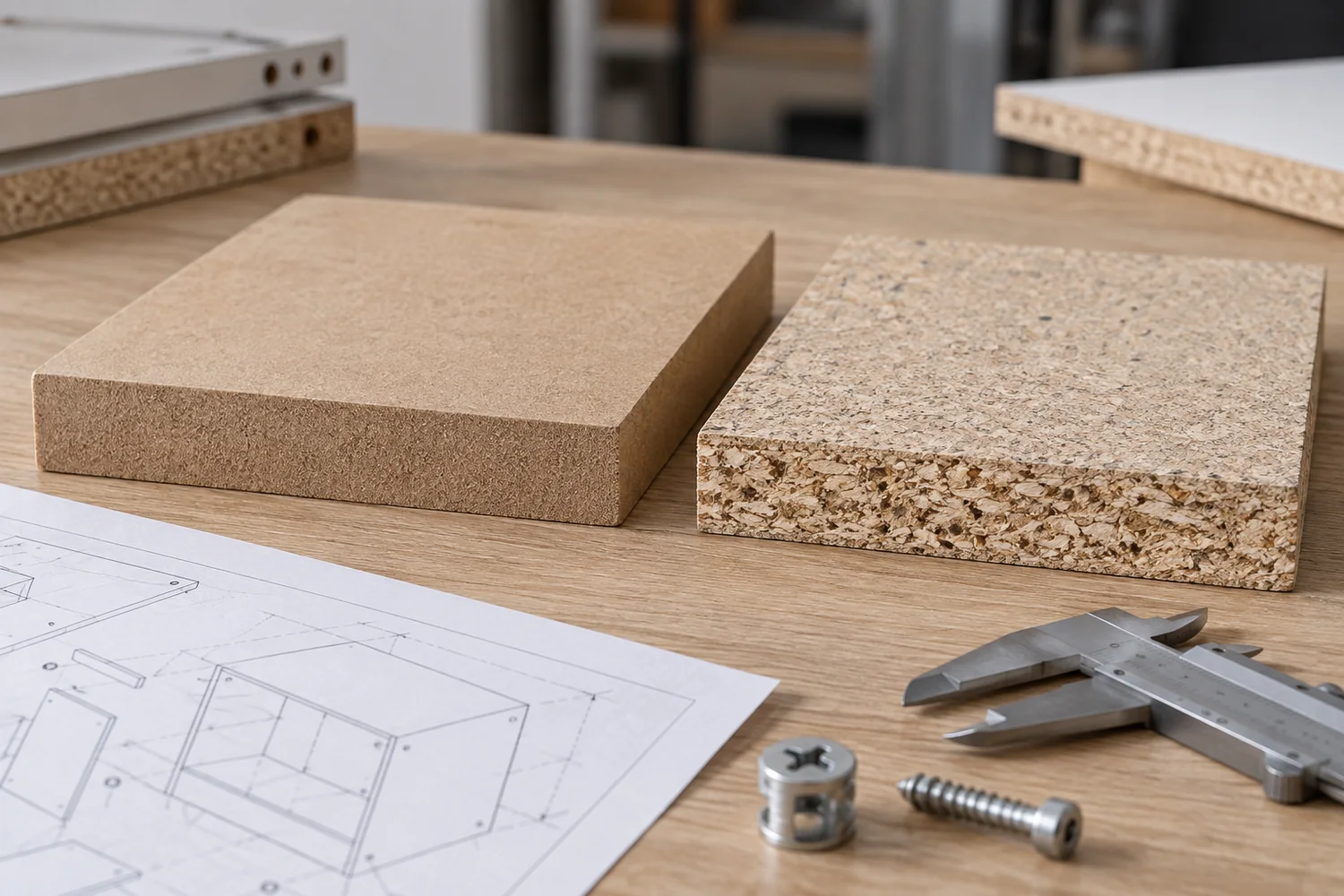
For importers, private-label brands and sourcing teams, choosing between MDF and particle board is not a whole-product vote. A flat-pack item may contain several panel components with different structural, machining, appearance and assembly requirements. The useful question is therefore not “Which board is best?” but “What should be specified and verified for each component?”
Direct Answer
Both MDF and particle board are engineered wood substrates, but MDF is formed from finer, more uniform wood fibers, while particle board uses larger wood particles or chips. Neither is universally better for flat-pack furniture. The right choice depends on the component, board specification, geometry, machining and hole preparation, hardware and joint design, surface and edge system, approved sample, and project-specific verification.
A material name is only the start of a production specification. Buyers still need to connect the substrate to the component, thickness, face and edge requirements, joint system, drawing or BOM, sample reference and QC plan. The broader Furniture Sourcing Guide covers the complete sourcing program; this article stays with the narrower MDF-versus-particle-board decision.
What Is the Manufacturing Difference Between MDF and Particle Board?
MDF and particle board are both manufactured wood-based panels, but their internal structures differ. MDF is formed from relatively fine, more uniform wood fibers combined with binder and pressed into a panel. Particle board is formed from larger wood particles or chips combined with binder and pressed into a panel.
That construction difference helps identify the substrates, but it does not establish a universal performance hierarchy. The words MDF and particle board do not, by themselves, tell a buyer the grade or density reference, panel thickness, joint design, intended exposure, surface system, edge treatment or approved acceptance criteria. They also do not prove strength, lifespan, load capacity, emissions or compliance.
The following comparison is therefore a specification map, not a scorecard.
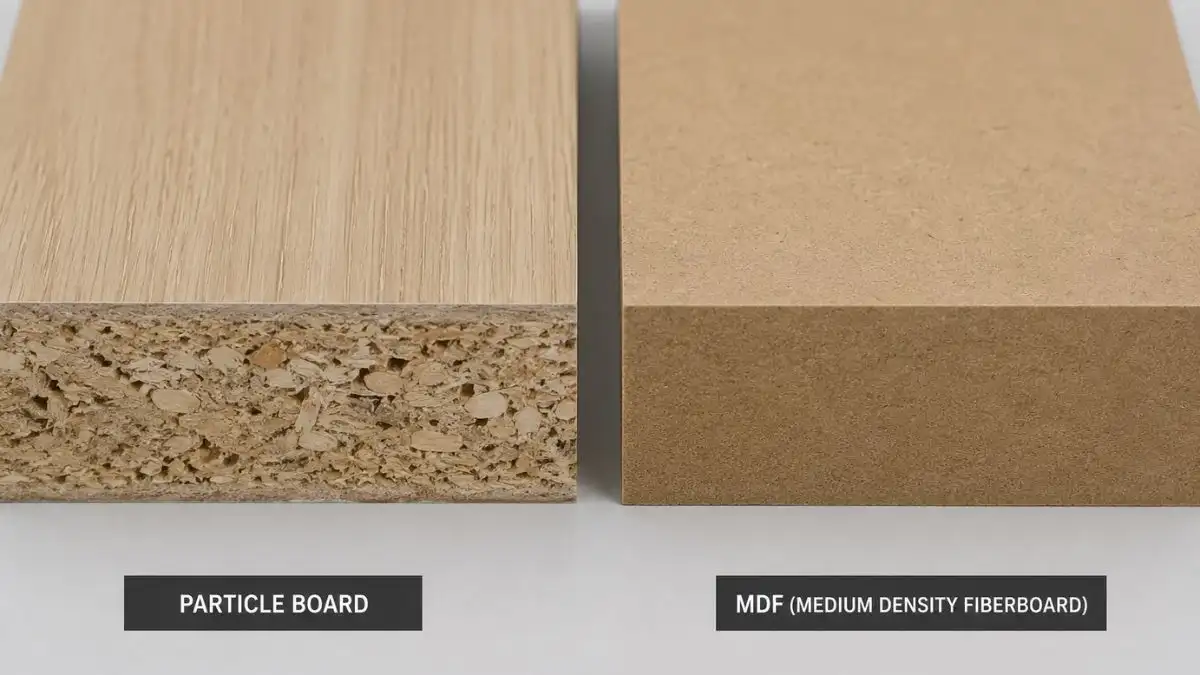
| Buyer Question / Specification Factor | MDF | Particle Board | What Buyer Should Verify |
|---|---|---|---|
| Basic board construction | Finer, more uniform wood fibers with binder, pressed into a panel | Larger wood particles or chips with binder, pressed into a panel | Named board type, supplier/product reference where applicable, and component record |
| Component application | Can be specified for a component when the full design and manufacturing context supports it | Can be specified for a component when the full design and manufacturing context supports it | Component role, thickness, geometry, support, joint and intended use; do not assign by material name alone |
| Machining context | Surface, routing, cutting and drilling behavior must be considered separately | Cutting, drilling, edge condition and other operations must be reviewed for the actual board | Actual grade/density where applicable, tooling, operation, geometry, sample result and acceptance point |
| Hole / fastener context | No universal screw-holding conclusion | No universal screw-holding conclusion | Fastener, pilot hole, insertion direction, edge distance, thickness, joint geometry and repeated assembly condition |
| Surface compatibility | Substrate remains separate from the decorative face system | Substrate remains separate from the decorative face system | Surface identity, visible face, component, decor/color, texture, finish and approval reference |
| Edge treatment | Requires a component- and project-defined edge specification | Requires a component- and project-defined edge specification | Edge material, coverage, appearance and acceptance reference without assuming the substrate determines the edge system |
| Appearance specification | Board identity alone does not define the visible result | Board identity alone does not define the visible result | Approved face, edge and corner appearance under the agreed comparison conditions |
| Evidence / sample verification | Verify the named component and approved revision | Verify the named component and approved revision | BOM/drawing, sample identity, measurements, machining, hardware fit, assembly and change record |
Why “MDF” or “Particle Board” Is Not a Complete Furniture Specification
An RFQ line that says only Material: MDF leaves important production decisions open. The same is true for Material: particle board. A usable component record should resolve the fields that influence how the panel is manufactured, assembled, approved and inspected.
At minimum, the buyer and supplier should align on:
- product, component name or part code, and revision;
- board type and the applicable grade, density or supplier reference where required;
- panel thickness and controlled dimensions;
- decorative surface or finish system for each relevant face;
- edge treatment and coverage;
- hole, machining and hardware or joint requirements;
- orientation, span, support and intended use or exposure where relevant;
- drawing, BOM and approved sample reference;
- project-specific tolerance, verification and change-control requirements.
These fields should remain connected. A panel thickness can affect finished geometry and hardware interfaces. A surface or edge change can affect appearance approval. A hardware substitution can require a different hole or installation condition. Recording each field without the component and revision can still leave the production team comparing unlike versions.
This is why material name alone ≠ production specification is more than a wording preference. It is the difference between a broad material label and a reference that can be followed from RFQ through sample approval, production and QC.
How Component Role Changes the Material Decision
Flat-pack furniture is a system of components and interfaces. A tabletop, shelf, cabinet side, drawer front, door, back panel and decorative panel do not perform the same role. Buyers should define the decision dimensions for each part instead of assigning one board to an entire product category.
| Component | Specification considerations |
|---|---|
| Tabletop | Substrate, thickness, surface and edge system, support and connection layout, intended use and appearance criteria |
| Shelf | Substrate, thickness, clear span, supports, orientation, finish and project-specific load verification |
| Side panel | Substrate, thickness, connector and hole layout, edge exposure, finish and dimensional tolerance |
| Drawer front or door | Substrate, face and edge appearance, machining, hinge/handle or other hardware interface, and approved visual reference |
| Back panel or drawer bottom | Substrate, thickness, orientation, fixing method and part identity |
| Decorative panel | Substrate, face treatment, routing or other confirmed machining requirement, edge quality and visual acceptance |
This table does not prescribe MDF or particle board for any listed component. It identifies the questions that must be closed before the material choice becomes production-ready. Strength, shelf sag, safe load and lifespan remain product-, structure- and test-specific; they cannot be ranked from the board name alone.
One furniture item can use both substrates. In a reviewed historical HOMVND evidence cohort of 25 furniture BOMs, three BOMs combined particle-board main panels with 3 mm MDF thin panels. This scoped example confirms that mixed construction is possible. It does not establish a full-line material policy, an industry frequency or a preferred formula, and the reason for any specific combination must still come from that product’s drawing, BOM, sample and approval record.
How the Substrate Connects to Surface, Edge and Appearance
A furniture panel has a substrate, but the substrate is not the decorative surface, edge treatment or finished appearance. A buyer may need to specify all of these separately:
component → substrate → decorative surface or coating finish → edge treatment → appearance reference
Paint, laminate, melamine and veneer may describe confirmed face-system roles in a project, but a visible face should not be used to guess the core. The trade term melamine is also not enough to establish a specific construction without confirmation. Detailed TFL-versus-HPL selection belongs to a separate surface-system comparison, not to this substrate article.
Edge treatment is another independent field. The panel record should identify which edges are covered, the approved material and appearance, and the acceptance reference. The substrate does not automatically determine the edge material or process, and this article does not prescribe edge-band materials, adhesives or machine settings.
For appearance approval, identify the component and visible face, then record the relevant decor or color, texture, gloss, grain or direction where applicable, edge relationship and approved sample. Two panels can appear similar in a photograph while using different cores, surfaces or edge treatments. Visual similarity is not substrate verification.
Hardware, Drilling and Machining: Why Context Matters
Claims about screw holding are especially easy to overstate. Current approved evidence does not support a universal MDF-versus-particle-board winner. Joint performance depends on the actual board, grade or density where applicable, component thickness, fastener, pilot-hole preparation, insertion direction, edge distance, joint geometry and initial or repeated assembly condition.
For a flat-pack program, buyers should review the board and joining system together. A generic hardware name is not enough if the mating part, hole diameter or depth, position, orientation and installation sequence remain unclear. Project samples, joint checks or an applicable test method should resolve the required result; the material label should not be used as a substitute for that verification.
Machinability also needs to be separated by operation. A qualitative surface characteristic does not prove that every cutting, routing, profiling or drilling operation will be easier. Routing finish, cutting effort, edge condition and drilling acceptance can respond differently to grade, density, tooling, geometry and process settings. Rather than publishing a broad “easier to machine” claim, the specification should name the required feature and the sample or QC point used to accept it.
Possible chipping, edge damage or poor hole quality should be recorded as an observation and investigated against the actual operation. Appearance alone does not prove a single root cause, and it should not be converted into a universal defect claim about either substrate.
What Buyers Should Verify During Sample Approval
The sample stage should turn the written component record into an approved physical and documentary reference. It is not enough to approve the assembled item from a distance or to confirm that “the board looks right.”
For each controlled component, verify:
- part identity and substrate against the current BOM or drawing;
- approved thickness and controlled dimensions;
- visible face, surface/finish and edge coverage;
- routing, drilling, hole position and other named machining features;
- fastener and hardware fit with the mating component;
- component orientation and trial or full assembly where applicable;
- appearance at the face, edge and corner;
- deviations, substitutions and the person responsible for approval;
- the sample, BOM, drawing, manual and other relevant revision references.
The Private Label Furniture Development guide covers the wider brief-to-sample and production-readiness workflow. For this material decision, the essential outcome is a traceable reference showing which substrate was approved for which component and version.
Sample approval does not guarantee mass-production conformity. It creates a comparison reference. If the substrate supplier, grade, dimensions, surface, edge, hardware, hole pattern or component design changes, the buyer and supplier should identify the affected scope and decide whether review, a new sample or additional verification is needed.
How to Carry the Approved Material Specification Into Production and QC
The same component-level record should continue through the sequence:
Buyer requirement → RFQ → sample → specification approval → production → QC
At production release, the active BOM, drawing, sample reference and approved changes should agree. Substitutions should be visible rather than absorbed into an informal “equivalent material” statement. Production and inspection records should identify the product, component and revision they cover.
QC can then compare material identity, thickness, surface and edge, holes and hardware, appearance, assembly and recorded changes with the approved reference. The detailed inspection workflow belongs in the Furniture Inspection and Quality Control guide; this article defines the material information that the inspection needs.
A material certificate or report should also be read by scope. It first supports the material, sample, method and conditions named in that document. It does not automatically prove the finished furniture specification, every production unit or compliance in a target market. Product-level claims may require traceability and additional product-, test- or market-specific evidence.
Buyer verification checklist
- Is each panel material tied to a named component and current revision?
- Are board type, thickness and any required grade, density or supplier reference recorded?
- Are substrate, decorative surface and edge treatment separate fields?
- Are holes, machining, fasteners and mating components reviewed as one interface?
- Does the approved sample identify the same material and document version?
- Are substitutions and deviations recorded with their affected scope?
- Does QC compare production with the approved component record?
- Are certificates or reports used only within their documented scope?
Quick answers for furniture buyers
Is MDF always better than particle board for flat-pack furniture?
No. Selection depends on the component, actual board specification, geometry, machining, joint system, surface and edge requirements, intended use and project verification.
What should buyers specify besides “MDF” or “particle board”?
Specify the component and revision, board reference and thickness, surface, edge, hole and joint requirements, intended conditions, approved sample, tolerance and QC reference.
Can one furniture product use both MDF and particle board?
Yes, an approved furniture design can use both MDF and particle board in different components when each component and interface is defined and approved; it is not a universal formula for every product.
Which board holds screws better?
There is no supported universal winner. Verify the actual board, fastener, pilot hole, insertion direction, edge distance, thickness, joint geometry and repeated assembly condition.
Can appearance confirm whether a panel is MDF or particle board?
No. The decorative face and edge can conceal the substrate. Verify the BOM, drawing, component record and approved sample rather than inferring the core from appearance.
How should buyers verify board material before production?
Match the component, BOM/drawing, substrate, thickness, surface, edge, machining, hardware fit, sample identity, revisions and approved deviations before release.
Does a material certificate prove the finished furniture specification?
No. A document supports only its named material, sample, method, conditions and scope. Finished-product or compliance claims require the relevant traceability and applicable evidence chain.
If you are defining materials for a new flat-pack furniture program, prepare the RFQ around the component, substrate, surface, edge treatment, hardware interface and approval reference—not the board name alone. That gives the buyer and supplier a clearer basis for sampling, production release and verification without assuming that one substrate is universally better.