
EU Formaldehyde Requirements for Furniture: A Buyer’s Evidence Checklist
A buyer’s evidence checklist for EU furniture formaldehyde requirements: scope, material-to-product traceability, test conditions and purchasing handover.
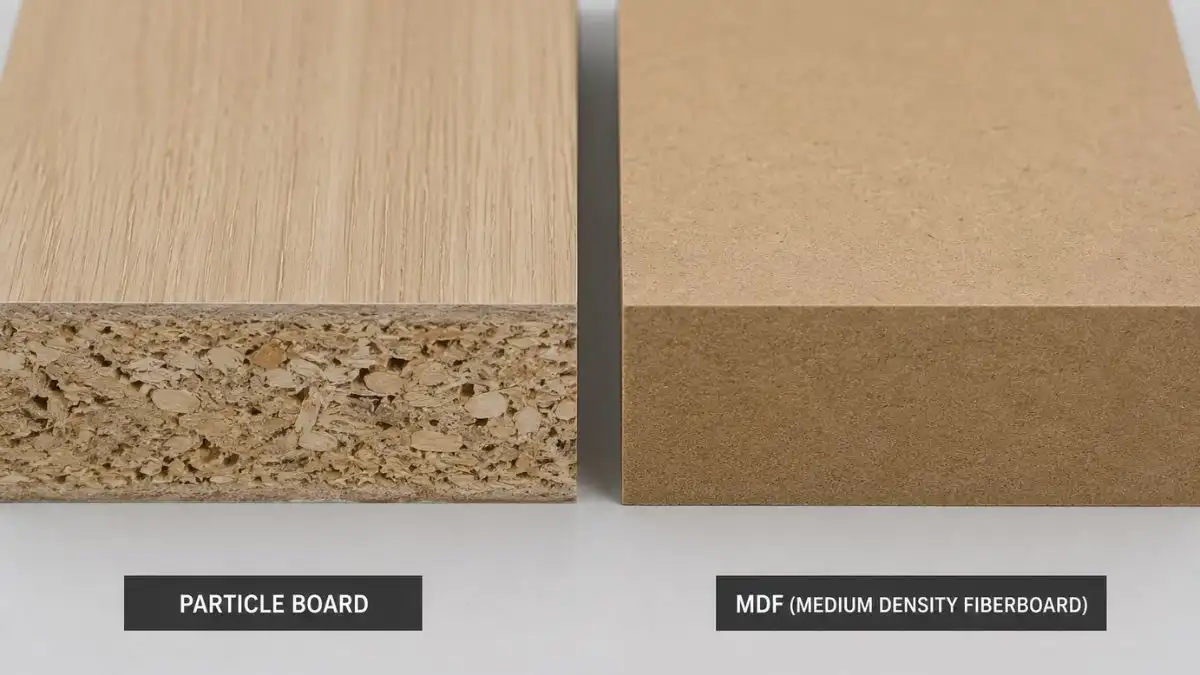
Material illustration: panels labelled MDF and particle board. The image identifies material types; it does not show an emissions test or establish compliance.
A supplier sends a board report with a low formaldehyde result. Can your purchasing team approve the cabinet that will be imported into the EU? Only after checking what the report measured, how it relates to the complete furniture item, and whether it covers the version you are buying.
For furniture within the scope of REACH Annex XVII Entry 77, the limit is 0.062 mg/m³ under the conditions in Appendix 14. The restriction applies to placing articles on the market after 6 August 2026. As of this guide’s review on 4 November 2026, that application date has passed. A material name, emissions-class label or report for an unrelated specimen is not enough to establish that the purchased furniture meets this requirement. [1–2]
This guide helps importers, private-label brands and online sellers turn supplier information into a product-specific evidence decision. It does not assess any HOMVND model. Use the checklist to identify what is established, what remains open and who needs to resolve it before purchase or shipment.
1. Check the Product’s Scope and Market Timing
Start with the intended market, actual use and complete product definition. Entry 77 covers formaldehyde and formaldehyde-releasing substances in articles, with separate limits for furniture and wood-based articles and for other articles. It is not simply a rule about raw MDF or particle board. Furniture does not move into the higher-limit category merely because it combines wood-based panels with metal or other materials. [1–2]
Ask the supplier to identify the materials and relevant treatments used in the proposed item, including components that are easy to overlook, such as back panels, drawer bottoms and bonded or coated parts. For help defining these components, use the MDF and particle board specification guide.
Check exclusions against the actual use
Entry 77(1) includes exclusions with specific conditions. The most relevant screening questions for furniture purchasing are:
- Exclusively natural presence: are the formaldehyde and formaldehyde-releasing substances exclusively naturally present in the materials used? “Wood” or “natural material” on a sales sheet does not establish this for an item with added adhesives, finishes or other components.
- Exclusively outdoor use: is the article exclusively for outdoor use under foreseeable conditions? A product advertised for both indoor and outdoor use should not be treated as exclusively outdoor. ECHA Q&A 2155 also says the assessment must consider foreseeable indoor use or storage, not just final intended use.
- Exclusively industrial or professional use: the exclusion does not apply where released formaldehyde leads to exposure of the general public under foreseeable use. Selling to a business, importer or retailer does not itself establish this exclusion. Ordinary household furniture bought wholesale for resale is not excluded merely because the purchase is B2B.
- Second-hand articles: these are excluded. Do not equate unsold new stock with second-hand furniture.
The full list also covers qualifying construction articles used exclusively outside the building shell and vapour barrier without emissions into indoor air; articles covered by Entry 72; and specified biocidal products, medical devices, personal protective equipment and food-contact articles within the legislation named in Entry 77. Check the exact wording before relying on an exclusion. A dining-room use or a “commercial furniture” description alone is not a classification decision. If the exclusion is material to the purchase, record the basis and have the importer’s compliance adviser or relevant authority clarify unresolved scope questions. [1–2]
Do not use the order date as the legal trigger
Regulation (EU) 2023/1464 entered into force on 6 August 2023; the article restriction applies after 6 August 2026. Those are different events. The separate restriction for the interior of road vehicles applies after 6 August 2027, not the furniture date. [1–2]
For purchasing, identify the relevant placing-on-the-market events in the actual supply chain. ECHA Q&As 2141 and 2147 explain that the restriction concerns any placing on the EU market and that producing an article before the application date does not exempt later placing on the market. An earlier purchase order or departure from the factory is not, by itself, a basis for exemption. Where stock or a shipment spans the application date, have the responsible EU business confirm the treatment of that situation before accepting a supplier’s date-based argument. [3]
2. Connect Material Evidence to the Furniture You Are Buying
A board report can be useful evidence about the identified board specimen under the reported method and conditions. It can help establish the material reference used in a component and inform a technical assessment. It does not automatically demonstrate the release from every finished item made with that board.
Recital 29 of Regulation (EU) 2023/1464 explains that the furniture and wood-based-article limit applies to the whole complex product, including products containing other materials. The purchasing question is therefore: what supports the conclusion for this complete furniture configuration? [2]
Build a traceable connection from the evidence to the product:
- Identify the tested object. Was it an unfinished board, a coated panel, a component, an assembled item or another defined specimen? Retain its photographs, identifiers and preparation details where available.
- Map it to the ordered version. Connect the board reference and supplier to the relevant component list, material specification, finish system and product revision.
- Explain broader coverage. If the conclusion relies on component data or a representative product, obtain the technical rationale, its assumptions and the configurations it covers.
- List unresolved differences. Identify components, materials, processes or configurations that the evidence does not yet address.
Do not simply add, average or copy numerical results from separate board reports into a furniture-level conclusion. Ask a laboratory competent in formaldehyde release measurement, together with the responsible compliance reviewer, to explain whether the available evidence and proposed assessment route support the complete article.
ECHA’s component-testing clarification matters here. Q&As 2142–2143 discuss component testing where whole-product testing is difficult or not feasible, for example because of size or shape. Q&A 2152 explains that, for furniture made by simple assembly, testing individual articles under the restriction’s test conditions may support the assessment if it allows verification of the total release from the complete furniture and no formaldehyde or formaldehyde-releasing product is added during or after assembly. These conditions are not met merely by collecting one report for the main board. Ask the technical reviewer to show how the proposed route satisfies them. [3]
This is not a blanket instruction to run an identical full test on every size or colour. Equally, membership of the same product series is not an automatic justification for extending coverage. The decision needs a documented, technically applicable basis for the versions claimed.
Labels such as E1, E0, CARB or TSCA should lead you to the underlying requirement and evidence. None of these labels alone establishes conformity with Entry 77 and Appendix 14. Avoid unsupported conversions or assumptions that a result under one method proves a result under another. Authenticity and general document checks are covered separately in How to Verify a Furniture Test Report.
3. Read the Result Together with the Test Conditions
The Entry 77 furniture limit concerns the concentration of formaldehyde released into test-chamber air, expressed in mg/m³. It is not a limit on the percentage or mass of formaldehyde contained in the board. A content result in mg/kg, an emission rate or a result from a different procedure should not be compared directly with 0.062 mg/m³.
The other-article limit is 0.080 mg/m³; it does not replace the furniture and wood-based-article limit. Both belong to the article restriction and its scope conditions. [1–2]
Ask how the report addresses Appendix 14
Appendix 14 sets cumulative reference conditions, including:
- Test-chamber temperature: 23 ± 0.5 °C.
- Relative humidity: 45 ± 3%.
- Loading factor: 1 ± 0.02 m²/m³, defined as total test-piece surface area divided by chamber volume. This corresponds to wood-based-panel testing. For other materials or products, where that loading is clearly unrealistic under foreseeable use, Appendix 14 permits loading factors following Section 4.2.2 of EN 16516.
- Air exchange rate: 1 ± 0.05 h⁻¹.
- Appropriate analytical and test-piece sampling methods.
- Chamber-air measurements at least twice daily, at least 3 hours apart, until sufficient data establish the steady-state concentration. Testing must be long enough to determine steady state and must not exceed 28 days.
The steady-state concentration is used to check the limit. A report that gives only a single early reading or says “28-day test” without explaining the result and conditions leaves a question to resolve. The maximum duration is not a rule that every test must run for exactly 28 days. [1–2]
Appendix 14 also permits data from non-reference conditions where reference-condition data are unavailable or unsuitable for the specific article and there is a scientifically valid correlation with the reference conditions. If that route is used, request the correlation basis and its applicability to the tested material or article. A method name, a supplier assurance or a generic conversion factor is not a substitute for that explanation.
Questions to send with the report
- What product or component was sampled, and how was it prepared and conditioned?
- Which faces and edges were exposed or sealed, and how does that represent the supplied configuration?
- Which loading factor and chamber conditions were used, and why are they applicable?
- Is the reported value a steady-state chamber concentration? Are units, calculation and any correlation clearly identified?
- What conclusion does the laboratory state, and what limitations or unresolved differences remain?
These are practical evidence-review questions. The laboratory should explain the technical method; the importer’s compliance reviewer should determine how that evidence supports the applicable obligation. A retailer may impose additional commercial testing or documentation requirements. Record those separately from the legal restriction.
4. Use a Procurement Evidence Checklist
Record a next action for each gap. “Received” describes a file transfer, not an approval decision.
On a narrow screen, scroll the table horizontally to reach the final column.
| Evidence received | What it can support | Question still to close | Next action / owner |
|---|---|---|---|
| Material label or general supplier declaration | The supplier’s stated material or compliance claim. | Which requirement, specimen, method and product revision support it? | Supplier provides the underlying evidence and product mapping. |
| Board or component report | The identified specimen’s reported result under stated conditions. | How does it support the complete furniture item, including other relevant components? | Supplier maps materials; laboratory or technical reviewer assesses the coverage basis. |
| Finished-furniture report | The tested furniture configuration and stated conclusion. | Does the order match the specimen and Appendix 14 route? Are variants included with a rationale? | Buyer and supplier compare revisions; technical reviewer resolves differences. |
| Result under different conditions | Data under the method actually used. | Is the non-reference route applicable, with a scientifically valid correlation? | Laboratory supplies the technical explanation and limitations. |
| Exclusion or old-stock argument | A proposed scope or timing position. | Do the facts satisfy the exact legal conditions? | EU responsible business obtains compliance advice or authority clarification. |
| Changed material, finish or construction | The previous evidence and an identified change. | Does the evidence remain applicable to the changed article? | Supplier records the change; reviewer decides whether clarification, more evidence or testing is needed. |
A useful purchasing status is specific: evidence supports the named version within the stated scope; material-level evidence only; product coverage unresolved; or additional technical assessment required. Commercial discussions can continue while gaps are being resolved, but do not mark the product compliant simply to release an order.
5. Recheck Evidence When the Product Changes
Review changes to the board producer or grade, component thickness, adhesives, coatings, laminates, edge treatment, dimensions, component quantities and assembled configuration where they could affect formaldehyde release or the representativeness of the evidence. A change to a finish may involve more than its visible colour. An unchanged SKU name does not establish unchanged construction.
Ask the supplier for a before-and-after record, the affected components and the reason the existing evidence is considered applicable. Have the technical reviewer decide whether the change is already covered, needs an explanatory assessment, or requires additional testing. Do not assume either automatic carry-over or automatic full retesting.
Hypothetical example: a buyer selects a cabinet whose main panels are linked to a board report. Before production, the back-panel source and the finish system change. The useful next step is to identify the new materials and revise the evidence mapping, then obtain a technical decision on the gaps. The main-panel report alone does not resolve them; the example does not establish that a particular retest is mandatory.
6. Close the Evidence Handover Before Order and Shipment
The lists below are recommended purchasing records, not a universal statutory document template. Entry 77 and Appendix 14 do not establish a standard “REACH certificate”, a CE-marking obligation or an EU Declaration of Conformity requirement for furniture under this restriction. A supplier declaration can record a position, but its title cannot replace supporting evidence. Other legislation may impose separate obligations. [1–2]
REACH Article 67 requires compliance with the applicable restriction. Agree who provides the product information, who explains testing and who makes the EU business’s compliance decision. Buying a laboratory service or accepting a supplier statement does not itself settle that decision.
Before placing the order
- Destination market, intended use and relevant placing-on-the-market timing.
- Model, variant and specification revision, with a component and material mapping.
- Any claimed exclusion, its factual basis and the person responsible for confirming it.
- Complete relevant reports and supporting assessments, with the Appendix 14 route and product coverage explained.
- Separate retailer or brand requirements, where applicable.
- An open-issues list: missing evidence, action owner, deadline and the agreed decision needed before proceeding.
The furniture product specification sheet guide helps organise the product reference against which this evidence is checked.
Before authorising shipment
- Confirm the production version and material references against the accepted evidence scope.
- Resolve substitutions and relevant changes; retain the resulting review or additional evidence.
- Link the shipment’s product and batch references to the applicable specifications and evidence records.
- Record who reviewed remaining issues and the basis for the shipment decision; keep the supporting information retrievable.
A visual or assembly inspection cannot measure formaldehyde release. Inspection can help check whether the goods match the agreed production reference; it complements the evidence assessment. See Furniture Inspection and Quality Control for that separate task.
If evidence is incomplete, ask the supplier for the missing product and material links, ask the laboratory to explain measurement and representativeness, and refer unresolved legal scope or timing questions to the responsible EU business’s compliance adviser or relevant authority. Keep each conclusion limited to what has actually been established.
Official Sources and Review Date
Legal text checked on 4 November 2026. The law, official implementation guidance, laboratory assessments and retailer purchasing specifications serve different purposes.
- REACH Regulation (EC) No 1907/2006, consolidated text dated 22 June 2026: Article 67, Annex XVII Entry 77 and Appendix 14.
- Commission Regulation (EU) 2023/1464: Article 2, recital 29 and the Annex introducing Entry 77 and Appendix 14.
- ECHA Questions and Answers: search “formaldehyde”; see Q&As 2141–2145, 2147, 2151–2152 and 2155 for timing, complex furniture, professional-use and outdoor-use explanations. These are official implementation explanations; the legal text remains the controlling source.
Prepare a Product-Specific Sourcing Brief
For a HOMVND furniture enquiry, share the destination market, intended use, model or reference, required materials and finishes, and the evidence requirements already identified by your purchasing team. Include open questions about product versions or available documents so they can be addressed in the project discussion.