
U.S. Clothing Storage Unit Requirements: A Buyer’s Sourcing Checklist
A sourcing checklist for assessing U.S. clothing storage unit scope, matching evidence to the proposed product version, and planning certificate and import handoffs.
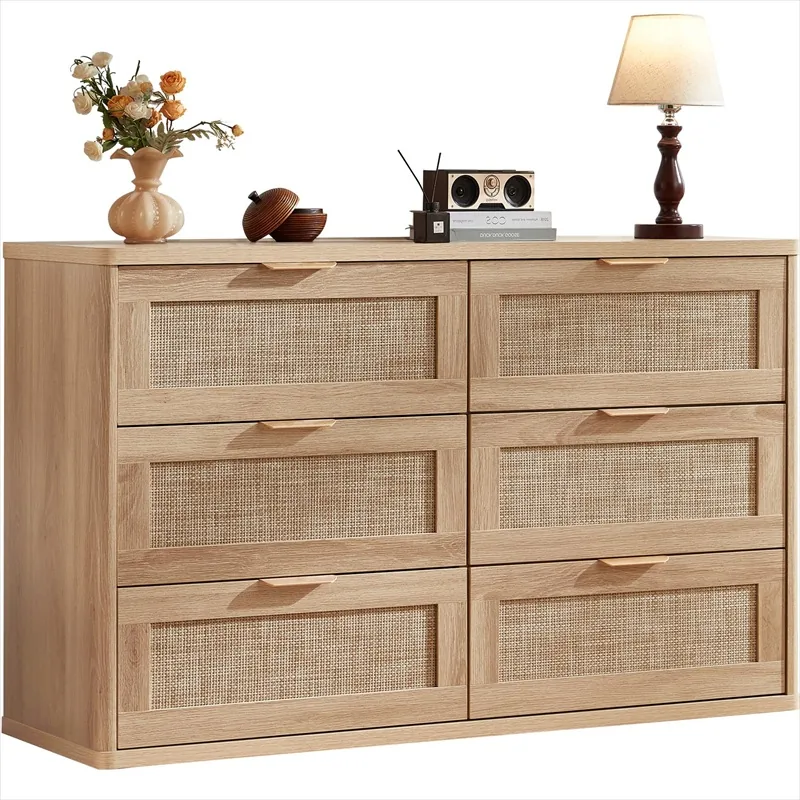
Product reference: HOM-SC-48BR, a wide six-drawer chest with woven-front inserts, shown with objects on top. The image illustrates furniture form; it does not establish the model’s regulatory scope, testing or compliance status.
Before asking for a price on a dresser, fabric drawer unit or wardrobe for the U.S. market, identify the product information needed to assess its regulatory scope. A familiar product name, an anchor kit or a report marked “PASS” does not answer that question on its own.
For importers, brands and marketplace sellers, the useful sequence is to define the proposed product, establish which requirements apply, match the evidence to that version and assign the certificate and import handoff. This guide follows that purchasing decision; it does not assess any HOMVND model as compliant or exempt.
Official-source check: November 3, 2026. 16 CFR part 1261 currently incorporates ASTM F2057-23 and applies to covered clothing storage units manufactured after September 1, 2023. For imports, that is the manufacturing date, not the entry date. Check the version incorporated in section 1261.2; a newer ASTM publication is not automatically the mandatory version.
Screen the Product’s Intended Use and Scope Together
The CPSC clothing storage unit guidance describes furniture with drawers and/or hinged doors intended for storing clothing, typical of bedroom furniture. Its scope criteria combine that purpose and construction with all of the following:
- Free-standing construction.
- Height of at least 27 inches.
- Product mass of at least 30 pounds.
- Enclosed storage volume of at least 3.2 cubic feet.
Request a dated specification and drawings for the version being quoted, its intended use, a product-mass record and a storage-volume calculation using the applicable definitions. Do not multiply the cabinet’s outside width, depth and height to establish enclosed storage volume. Do not substitute carton gross weight for product mass. If the supplier provides only shipping dimensions or a marketing sheet, keep the scope decision open.
CPSC’s listed exclusions include bookcases and entertainment furniture; office and dining-room furniture; jewelry armoires; underbed drawer storage; occasional/accent furniture not intended for bedroom use; laundry storage/sorting units; built-in units intended to be permanently attached to the building; and clothing storage chests as defined in ASTM F2598. Match the actual design and intended use to the exclusion being considered. A category name or a room shown in a sales photograph is not a sufficient basis for that decision.
Fabric drawers are not an automatic exemption. CPSC expressly includes fabric dressers when they meet the scope criteria. Its guidance describes a drawer as a compartment intended to slide in and out and stay with the product during normal use. Review the proposed drawer construction and the complete scope inputs rather than treating fabric, a metal frame or a removable-looking bin as a shortcut to an answer. Use a qualified laboratory or product-compliance specialist when the construction or measurement basis is unclear.
Request Evidence for Four Different Functions
For a unit within scope, separate stability evidence, the anti-tip device, warning labels and the instructions supplied with the product. They serve different purposes and should refer to the same production version.
- Stability evidence: CPSC identifies three stability tests addressing clothing load, horizontal force, and carpet with child weight. Request the complete report or other applicable testing records against the incorporated standard, with the specimen identity, configuration and results. Where an interlock is used, confirm how it was evaluated and represented in the tested configuration. This is a request for evidence, not a substitute test procedure.
- Anti-tip device: identify the supplied kit and its supporting evidence. The CPSC CSU FAQ states that a kit meeting ASTM F3096 must be packaged with the unit and that the unit must meet the stability testing requirements without the kit installed. Including anchors does not replace stability evidence.
- Warning labels: obtain the proposed artwork and placement reference for the actual design. CPSC states that the prescribed text and pictograms depend on intended use and product features. Ask the reviewer to check the applicable label requirements, rather than copying a label from another cabinet.
- Instructions: obtain the current assembly and anchoring instructions and check that the parts, drawer hardware, kit and illustrated installation match the supplied configuration. This purchasing check connects the documents to the goods; a manual is not proof of a test pass.
Compare the report’s model, photographs, dimensions, drawer arrangement, hardware and configuration with the quoted version. If several variants are said to be covered, request the documented basis for that coverage. Our furniture test-report verification guide explains document identity and applicability in more detail. Production checks against the approved reference belong in the furniture QC process; they do not replace the required test evidence.
Confirm the Certificate Path and Responsible Party
For covered general-use products, a General Certificate of Conformity (GCC) is based on testing or a reasonable testing program. General-use certification does not universally require a CPSC-accepted third-party laboratory, but it still needs evidence supporting compliance with the applicable requirements.
A Children’s Product Certificate (CPC) follows the children’s-product pathway, generally involving testing by a CPSC-accepted third-party laboratory for the applicable rules. A children’s product is designed or intended primarily for children 12 years of age or younger. The CSU rule’s purpose of protecting children from tip-overs does not make every dresser a children’s product. Resolve the intended-user classification before choosing the certificate and testing pathway.
For imported finished products requiring certification, the importer as defined in 16 CFR part 1110 is the responsible finished-product certifier. For U.S.-manufactured products requiring certification, section 1110.7(b) assigns responsibility to the manufacturer; for privately labeled U.S.-manufactured products, the private labeler must issue the certificate unless the manufacturer does so. Identify the responsible entity explicitly; a supplier’s or laboratory’s report is not itself that entity’s certificate. Another party may assist with testing, certification or data entry within the permitted framework, but section 1110.15 leaves the certifier legally responsible for the certificate information.
Where the revised part 1110 applies, use section 1110.11 to assemble the certificate information: a unique product identifier and matching description; applicable rule citations; certifier and records contact; manufacturing date and location details; testing date and location details; and the certifier’s attestation. Identify any claimed statutory or regulatory testing exclusion; a testing exclusion does not by itself remove the certificate obligation. The CSU citation is “16 CFR part 1261 – Clothing storage units.” The certifier must also identify other applicable CPSC rules; a CSU-only review is not a complete review of every requirement for the product.
Plan the Certificate Data Handoff Before Import
The official correction to the part 1110 rule sets one effective date, July 8, 2026, and two applicability dates: July 8, 2026 generally, and January 8, 2027 for products imported into a Foreign Trade Zone and subsequently entered for consumption or warehousing. The FTZ applicability date is still upcoming as of this guide’s source check.
For this commercial sourcing task, eFiling concerns imported finished products requiring certification and offered for consumption or warehousing. U.S.-manufactured products remain subject to applicable certificate requirements but not import eFiling.
The CPSC eFiling FAQ confirms that low shipment value is not an exemption. Sample-only treatment requires that products not be distributed into U.S. interstate commerce or used by U.S. consumers; a “sample” label alone is insufficient.
Before shipment, agree who supplies and verifies the product identifiers, manufacturing and testing details, certificate data and supporting records, and who passes the confirmed data to the filing party. Follow the CPSC importer guidance for the responsible-party arrangement. Keep the certificate connected to the version and goods being imported. For the broader invoice, packing-list and shipment handoff, use the furniture import guide.
Use a Compact Evidence Checklist Before Ordering
The table separates a request for information from a completed procurement decision. On a small screen, scroll horizontally to read the final column.
| Information to confirm | Evidence to request from the supplier | Next step if missing |
|---|---|---|
| Intended use, structure and free-standing status | Current drawings, product description and proposed sales presentation | Clarify the actual use and construction before deciding scope |
| Height, product mass and enclosed storage volume | Measurement records and a calculation using the applicable definitions | Obtain missing inputs; refer uncertain measurements for technical review |
| Model, revision and stability evidence | Complete testing records; specimen identity; standard version; variant-coverage basis | Resolve mismatches or obtain the additional evidence the reviewer identifies |
| Anti-tip kit, warning labels and instructions | Kit identity and evidence; artwork; placement; current manual and pack-out list | Align the documents and packed components with the reviewed version |
| Certificate pathway and import handoff | Product and test data for the certifier; manufacturing details; records contact | Confirm classification, responsible certifier and current filing requirements |
| Changes and the next purchasing decision | Change list, revised specifications and a documented evidence-applicability review | Keep affected decisions open until the identified review or evidence gap is closed |
Recheck Changes and Choose the Next Purchasing Step
A change in overall dimensions, product mass, drawer count or depth can affect scope inputs or the configuration being evaluated. Changes to runners, stops, interlocks, legs, counterweights or other structural hardware can also affect the relationship to the tested specimen. Ask what changed, which scope inputs or test conditions it affects, and whether the existing evidence still supports the revised version.
Do not assume that every modification requires a complete new test program, or that keeping the same model number preserves all evidence. For children’s products, a material change that could affect compliance triggers third-party testing and a new CPC under 16 CFR 1107.23; the extent of testing depends on the change and may be limited to an affected component under the rule’s conditions. Have the responsible certifier and an appropriately qualified laboratory or specialist determine the applicable review and testing scope, then update the affected specifications, labels, instructions and certificate information.
- Continue quotation discussions when the proposed version and intended market are clear, with any outstanding evidence work identified in the quotation scope. A price discussion is not shipment approval.
- Request missing information first when mass, storage volume, product identity or the relationship to a report is unresolved. Keep the affected scope or compliance decision pending.
- Seek technical or regulatory confirmation when classification, measurement definitions, variant coverage or changes cannot be resolved from the available records. Do not convert uncertainty into a supplier assurance.
For an initial sourcing inquiry, provide:
- The reference model or drawings, proposed revision and requested changes.
- The U.S. destination, intended use, intended users and sales channel.
- Available height, product-mass and enclosed-storage information, identifying what remains unknown.
- The requested quantity, packaging and document needs, plus any existing evidence references.
- The importing/certifying entity if known, and the contact coordinating the evidence review.
Use these details to send a furniture sourcing inquiry. They give the discussion a defined product and evidence scope without assuming that a listed model already meets the requirements for your project.