
TFL vs HPL for Furniture Manufacturing: What Buyers Should Specify
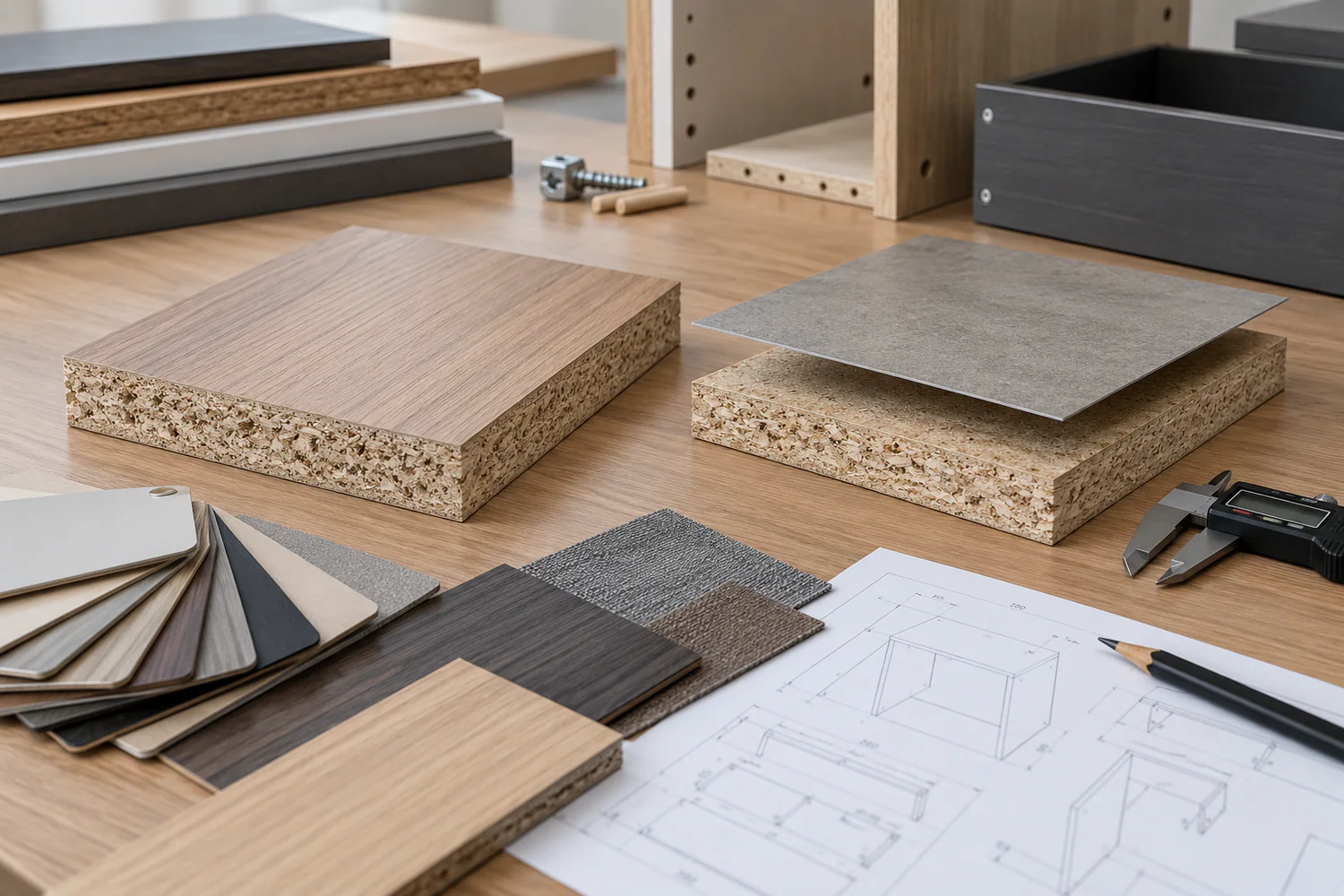
TFL and HPL are often compared as if one name could settle a furniture material decision. For an importer or private-label team, the more useful question is whether the supplier has defined the complete panel system for the intended component—and whether that system can be approved and checked consistently.
Direct Answer
TFL and conventional HPL are decorative laminate surface systems with different constructions: TFL decorative paper is fused directly to a named substrate, while HPL is made as a separate multilayer sheet and then bonded to a suitable substrate. Neither term names the substrate or proves a universal quality level. Buyers should specify the complete panel system, appearance reference, edge requirements and approval criteria.
This distinction matters because a finished furniture panel contains several separate layers of information: the substrate, decorative surface, edge treatment, any relevant coating or finish, and the final approved appearance. A generic surface name does not replace those fields. The broader Furniture Sourcing Guide places this decision within the full sourcing program; this article focuses on the surface-system specification.
What Is the Construction Difference Between TFL and HPL?
TFL means thermally fused laminate. In this construction, melamine-resin-treated decorative paper is fused directly to a named substrate under heat and pressure. The decorative layer and the substrate become the panel construction being specified. A buyer still needs to identify the substrate, component, panel thickness, face assignment and appearance requirements; “TFL” alone does not contain that information.
Conventional HPL means high-pressure laminate made as a separate multilayer sheet. That sheet is subsequently bonded to MDF, particle board or another suitable substrate to create the required furniture panel. The HPL sheet identity, bonding arrangement and named substrate therefore remain distinct specification fields.
This simplified comparison does not cover compact laminate or every product sold under an HPL-related trade description. Grades and special constructions should be confirmed from the applicable product documentation rather than inferred from the category name.
| Buyer Question / Specification Factor | TFL | Conventional HPL | What the Buyer Should Verify |
|---|---|---|---|
| Surface construction | Decorative paper is fused directly to the substrate | Multilayer laminate sheet is made separately, then bonded to a suitable substrate | Confirm the actual construction, not only the trade name |
| Relationship to substrate | Substrate is part of the direct-fused panel construction | Substrate sits beneath the separately made sheet | Name the substrate, panel thickness, component and revision |
| Component/application | Must be assigned to the relevant panel face and component | Must be assigned to the relevant panel face and component | Record where each system applies in the drawing or BOM |
| Decor and appearance | Decor/color, texture, gloss and grain/direction may need control | Decor/color, texture, gloss and grain/direction may need control | Approve the relevant face under defined project conditions |
| Edge relationship | Face system does not define the edge treatment | Face system does not define the edge treatment | Specify and coordinate the edge separately |
| Sample approval | Sample can establish an approved reference | Sample can establish an approved reference | Record sample ID, date, component, revision and approval scope |
| Production verification | Compare current production with the specification and approved reference | Compare current production with the specification and approved reference | Check identity, revision, appearance, edge coordination and changes |
The table is not a performance ranking. Durability, scratch behavior, impact response, moisture response and other performance questions depend on the actual product, complete panel system, application and relevant test evidence. They cannot be concluded from “TFL” or “HPL” alone.
Do TFL and HPL Describe the Surface or the Substrate?
Both terms identify the decorative surface construction, not the core material by itself. A furniture panel can be understood as a system: a named component has a specified substrate, receives a specified decorative surface, and has separately defined edges and appearance requirements. The production reference then connects those fields to the correct drawing or BOM revision.
The surface cannot be used to infer the substrate. A woodgrain decor, for example, does not reveal whether the core is MDF, particle board or another suitable material. Conversely, specifying MDF or particle board says nothing complete about the decorative face. Buyers who need to evaluate the substrate decision can use the separate MDF vs Particle Board for Flat-Pack Furniture guide without turning this surface comparison into a repeated substrate article.
The practical rule is to keep these layers separate:
- Substrate: the named core material and applicable grade or supplier reference.
- Decorative surface: the confirmed TFL, conventional HPL or other surface construction.
- Edge treatment: the separately specified edge material and process requirement.
- Coating or finish: any additional applicable finishing system, identified separately.
- Final appearance: the approved combination of color, decor, texture, gloss, direction, faces, edges and corners.
This separation makes the specification easier to approve and later investigate. It also prevents a change in one layer from being obscured by an unchanged general description of the overall panel.
Is “Melamine” or “Laminate” a Complete Specification?
Usually not. In trade communication, “melamine” may refer to melamine resin, shorthand for a familiar panel type or another context. Treat the term as TFL only after the direct-fusion construction has been confirmed. A phrase such as “melamine board” may be useful during an early conversation, but it is not precise enough for production approval.
“Laminate” is also an upper-level or trade term. It does not automatically mean conventional HPL, and it does not automatically mean TFL. The buyer should ask what the decorative layer is, how it is made or applied, which substrate it is paired with, and which product or grade reference applies.
Appearance language requires the same discipline. Decor or color, texture, gloss and grain direction are different fields. A matching color name does not prove that two surfaces have the same texture or gloss, and similar woodgrain visuals do not establish identical constructions. The RFQ and approval record should use the confirmed construction identity together with the appearance fields that matter for the component.
What Should Buyers Specify Besides TFL or HPL?
A useful RFQ converts a general surface preference into component-level instructions. The exact fields depend on the project, but the specification should make the following relationships clear:
- Product, component and revision. Identify the SKU or program, component code, drawing or BOM revision, installation direction and visible orientation.
- Substrate and panel thickness. Name the substrate and the applicable supplier or grade reference where required. State the project-specific nominal or finished thickness and how it will be verified; do not rely on a universal category value.
- Surface construction. State TFL, conventional HPL or another confirmed system. If opposite faces differ, identify each face separately. Include the applicable product or grade reference where it affects the construction.
- Appearance. Record decor or color, texture, gloss, grain direction, visible faces and any component-to-component alignment requirement.
- Component application. Show where the surface applies in the drawing, BOM or finish schedule. The same product may use different surface assignments across different parts.
- Edge requirement. Identify which edges require treatment and reference the separately controlled edge specification. Do not assume the face material settles the edge choice.
- Approved reference. Record the sample ID, date, component, revision and exactly what the sample approves.
- QC and change control. State the comparison method, project acceptance reference, sampling or disposition responsibility where applicable, and the substitutions that require review or reapproval.
This structure is more useful than a generic request for a “TFL panel” or “HPL finish.” It lets the supplier quote, sample and manufacture against the same component identity. It also gives buyer-side QC a traceable reference when a current unit must be compared with what was approved.
How Should Surface and Edge Requirements Be Separated and Coordinated?
TFL or HPL defines the decorative face system. It does not determine the edge-band material, edge-banding process, adhesive route or machine settings. Those are separate decisions and should remain separately documented.
The two specifications still meet at a visible interface. Buyers may need to coordinate the face and edge for decor or color, texture, gloss, grain direction and the appearance of corners. The component drawing should also indicate which edges are visible and which require treatment. A face sample with no edge or corner may therefore be insufficient if the completed product exposes those interfaces.
Coordination does not require expanding the surface specification into an edge-banding guide. Material comparisons, thickness selection, adhesive systems, processing steps and peeling troubleshooting belong to a dedicated edge specification. In this article, the essential buyer instruction is narrower: approve the face and edge as separate systems, then review their intended visual relationship on the relevant component.
How Should Appearance Be Approved Before Production?
Appearance approval should be traceable to a physical or otherwise project-approved reference, not a small digital image alone. Screen settings, compression, lighting and scale can all limit what a digital preview communicates. The approval record should identify the sample, date, component and revision and state which characteristics are within scope.
Depending on the product, that scope may include decor or color, texture, gloss, grain direction, visible face, adjacent-component relationship, edge and corner appearance. If viewing or measurement conditions matter, the project should record the applicable method rather than inventing a universal tolerance.
The sample also needs a clear role. It can establish an approved reference for the named component and revision, but it does not prove that every mass-production unit will match. Production still needs to be compared with the current specification, the approved reference and the correct revision. Any proposed substitution or change to the surface, substrate, appearance field, edge relationship or relevant process should be recorded and routed for review or reapproval as applicable.
For programs that need the wider brief-to-sample, revision and production-release sequence, the Private Label Furniture Development guide provides the broader workflow. Here, the key outcome is a surface reference with a defined approval scope.
What Should QC Verify, and What Does a Defect Not Prove?
Surface QC should begin with identity and traceability. The inspector needs the current component and revision, the named substrate and surface construction, the correct face assignment, the approved appearance reference, the separate edge requirement and any documented changes. Inspection can then compare the observed unit with those references.
Relevant checks may include decor or color, texture, gloss, grain direction, visible-face assignment, face-to-edge coordination, surface condition and visible defects. The project must define the applicable observation conditions, acceptance reference and disposition route; there is no universal tolerance that follows automatically from the TFL or HPL name.
A scratch, mismatch or delamination is an observation, not a confirmed root cause. The appropriate sequence is observation → possible-cause investigation → inspection point → project verification. Handling, product identity, batch, viewing conditions, bonding or exposure may be investigated where relevant, but appearance alone does not establish which mechanism occurred. The detailed inspection workflow belongs in the Furniture Inspection and Quality Control guide.
What is the difference between TFL and HPL?
TFL decorative paper is fused directly to a named substrate. Conventional HPL is a separate multilayer sheet that is later bonded to a suitable substrate. The difference identifies construction, not a universal performance winner.
Is TFL the same as melamine or laminate?
Not automatically. “Melamine” and “laminate” can be broad trade terms. Confirm the actual construction before treating the description as TFL, HPL or another system.
Do TFL and HPL describe the substrate?
No. They describe decorative surface systems. The substrate, panel thickness, component and revision must be specified separately.
Can MDF or particle board be used under TFL or HPL?
Yes, depending on the specified construction. TFL is fused directly to its named substrate, while conventional HPL can be bonded to MDF, particle board or another suitable substrate. Buyers should confirm the actual pairing for the component rather than assume it from the surface name.
What should buyers specify besides “TFL” or “HPL”?
Specify the component and revision, substrate, panel thickness, face assignment, product or grade reference where applicable, decor/color, texture, gloss, grain direction, edge requirement, approved sample, QC reference and change-control responsibility.
Is HPL always better than TFL?
No universal conclusion is supported. Performance depends on the actual product, complete panel system, component, use conditions and relevant test evidence. The choice should follow the project specification and verification plan.
How should surface appearance be approved before production?
Use an identified sample or project-approved reference that records the component, revision and approval scope, including relevant face, edge and corner characteristics. Then compare production with the current specification and that approved reference.
Does the surface material determine the edge treatment?
No. The face system and edge treatment are separate specifications. They should be coordinated for the intended appearance and component but not treated as the same material or process decision.
For a project-level review, buyers can share the target component, substrate, decor, texture and gloss direction, visible faces, edge requirements and sample expectations. The goal is not to select a universal winner; it is to create a complete, traceable panel specification that the supplier and buyer can approve and verify against the same reference.