
Validating Flat-Pack Furniture Instructions with a First-Use Trial
Use first-use observations to decide whether to revise instructions, relabel parts or investigate the product before accepting an assembly guide.
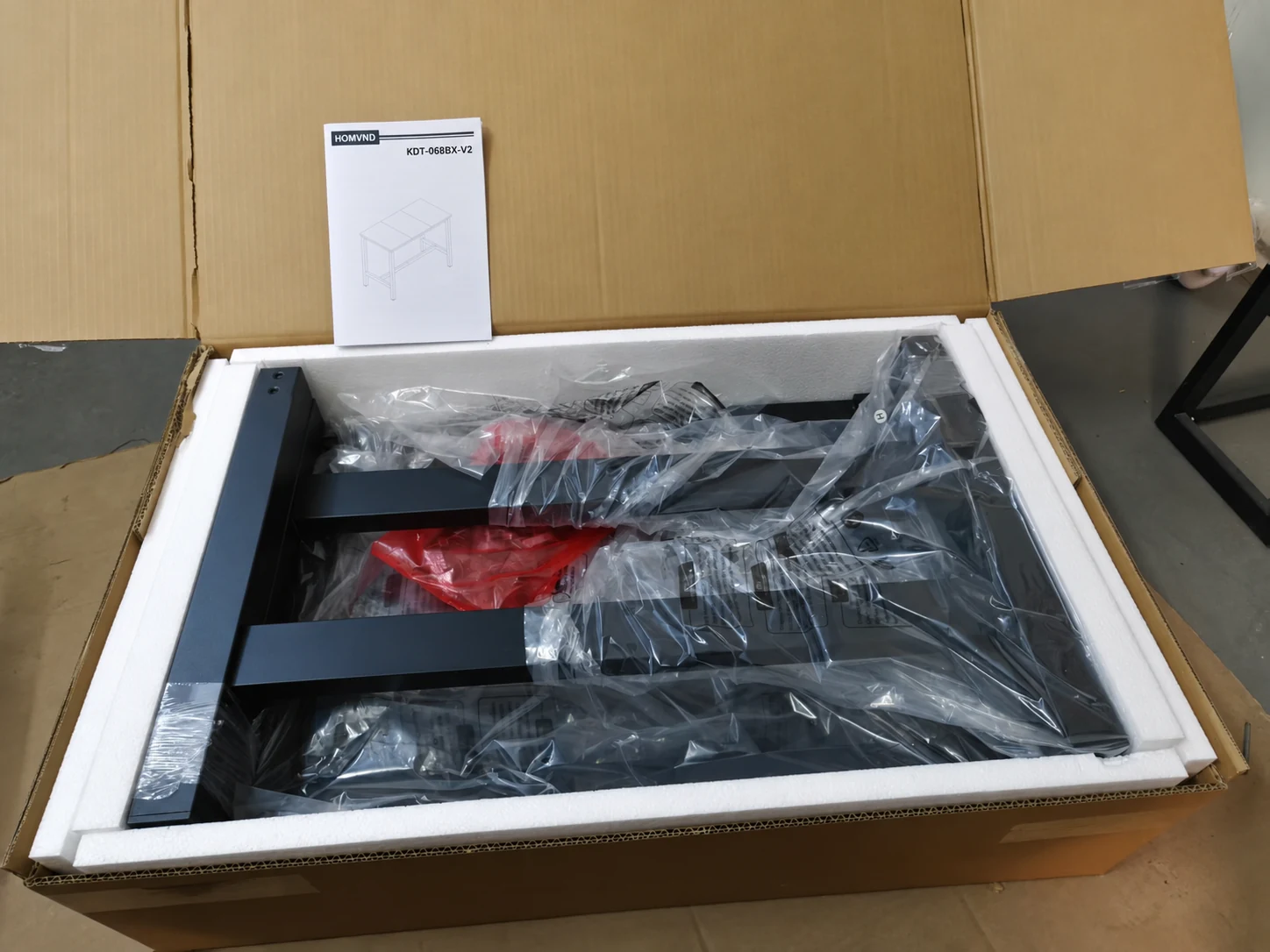
Instruction booklet cover beside bagged furniture components and foam inserts in an open carton.
A first-use trial helps a buyer see whether someone unfamiliar with a flat-pack furniture item can identify its parts, understand their orientation and follow its assembly instructions under agreed conditions. The useful result is a decision about what to change and what can be accepted—not simply a completed piece of furniture.
For importers, private-label brands and ecommerce purchasing teams, this is a way to examine instructions before approving them for the intended customer. The method below is a procurement recommendation, not a mandatory standard or a claim that HOMVND has performed a particular trial.
In anonymized buyer correspondence, one query questioned whether a part code should be “3” or “C”; another asked for part H to be changed in the manual. These are real identification and documentation questions, not recorded first-use trial results. They show why checking the finished assembly alone does not answer every question about the instructions.
1. Choose a Trial That Answers a Specific Question
Consider a first-use trial when introducing a new instruction booklet, changing a critical step or part label, or investigating reports that users cannot understand an assembly task. It need not become a requirement for every order. Start with the uncertainty: can the intended user distinguish similar panels, find the right fittings, interpret a drawing or work out when to turn the assembly?
Use the furniture inspection and quality control guide for physical fit, hole alignment, connector engagement and routine assembly checks. Here, the focus is what the user understands, what assistance they need and how those observations change the instruction-release decision.
2. Define the Starting Conditions
Identify the product configuration, component and hardware kit, packaging or label arrangement, and instruction version being examined. Keep the actual booklet or digital file used with the record. If the trial starts with unpacking, preserve the intended pack-out; if parts are already laid out, state that limitation. A pre-sorted kit does not show whether users can find the same parts in the supplied packaging.
Describe the intended user and select participants whose relevant experience and language comprehension make sense for that audience. Record whether each participant has assembled this model, seen its instructions or worked with similar furniture. An experienced supplier assembler can check technical accuracy, but their completion alone does not demonstrate first-use understanding by a customer unfamiliar with the item.
Agree which tools, instructions and help are available. Use the product’s own requirements for tools, working space, number of people and safe handling. If the task calls for two people, do not test it as a solo assembly challenge. Include a linked video or customer-support route only if it is part of the intended experience, and record when it is used.
Before starting, tell participants they can ask for help or stop. Agree who observes and who can intervene for safety. Stop if a dangerous condition appears or the task requires forcing a connection, improvising a tool or bypassing an instruction. Record where and why the trial stopped; completing the observation is never a reason to continue an unsafe operation.
3. Observe the Difficulty Before Explaining the Answer
Follow the participant through the agreed task. Record the instruction step and what actually happened: a pause while comparing parts, a mistaken fitting selection, a reversed panel, a request for clarification or a return to an earlier step. Note what the participant was looking at and what they said, rather than immediately writing “unclear manual.” A pause alone does not establish its cause.
Where it is safe to do so, allow the participant to interpret the material before explaining it. A neutral question such as “What are you trying to work out here?” can clarify the observation without supplying the solution. Record the question too. If the observer points to a label, identifies a part, demonstrates a movement or completes a step, log that intervention. Do not count the assisted step as an unaided completion.
Use a separate observation entry for each difficulty. The compact fields below are suggestions, to be used with the trial conditions recorded above; they are not a required form or a scoring system.
| Field | What to record |
|---|---|
| Step / part | Instruction page or step; part or fitting involved. |
| Observed action | Pause, misidentification, reversed orientation, help request or rework; relevant words used. |
| Help given | Who said, pointed to or did what; any tool or support used. |
| Immediate result | Continued unaided, continued with help, reworked or stopped; reason for stopping. |
| Cause to check | Instructions, identification, physical issue or unresolved; supporting observation. |
| Revision / recheck | Proposed change, responsible person, affected steps and follow-up finding. |
| Decision / open issue | Accepted scope or hold, reviewer and date; remaining action and owner. |
4. Separate the Cause from the Symptom
Review the observation with the people responsible for the instructions and product. Use the actual parts and documents to investigate; more than one cause may contribute.
- Instruction wording, drawing or sequence: the correct parts are present and identifiable, but the view does not reveal orientation, a symbol is unexplained or a dependency appears too late. Consider a clearer view, a more specific cue or a revised sequence, then check the change against the product.
- Part or packaging identification: a code is absent, hidden, duplicated or inconsistent between a component, bag and booklet. Correct the identification system or its visibility as appropriate; adding another paragraph cannot make a missing physical label visible.
- Physical part, hardware or structural issue: the supplied kit contains an incorrect component, a part is damaged or does not fit as specified, or the approved assembly sequence is not physically workable. Refer it to the supplier’s technical or quality contact. Do not rewrite the instructions to normalize forced alignment or an unapproved workaround.
- Unresolved: the observation does not yet distinguish a mistaken selection from a wrong component or an ambiguous drawing. Keep the competing explanations and the next investigation action. Do not assign the failure to the manual merely because that is the document under review.
Ask the supplier to confirm the intended assembly method when that is uncertain. Keep the initial observation separate from a later expert demonstration: a demonstration may help diagnose the issue, but it does not erase the user’s difficulty.
5. Revise, Then Recheck the Affected Task
Connect each proposed change to the observation it addresses. Have the responsible technical reviewer check that a new drawing, label or sequence remains consistent with the actual product, hardware and safety instructions. A graphic editor can improve the presentation; product-specific technical decisions need the appropriate product reviewer.
Recheck the affected step together with the steps that supply its parts or depend on its result. For example, changing when a rail is fitted may alter how the next panel is positioned or a fastener is reached. If the change alters the overall sequence, broaden the recheck accordingly. Do not declare the whole manual accepted after looking only at a corrected picture.
A returning participant already knows something about the product and the earlier problem. Their second attempt can help check the correction, but it is not a fresh first-use observation. Where the decision depends on unfamiliar-user understanding, use a participant who has not seen the solution where feasible. If that is not possible, record the familiarity limitation and keep the acceptance decision correspondingly narrow.
Hypothetical example: a label problem changes the revision
A participant repeatedly turns a panel to match the booklet’s drawing. The observer points out a small label on its reverse, and assembly then continues. Recording only “completed” would hide the help that made the step possible.
The review finds that the label is not visible in the packed position and that the drawing does not show the distinguishing face. Instead of adding a general “check the correct part” warning, the proposed revision changes label placement and adds an orientation view. The supplier confirms that the revised label position is suitable for the part.
The recheck starts from the relevant unpacking step and continues through the following connection, using the revised pack and booklet with someone unfamiliar with the solution. The buyer records the result before deciding whether to accept that change. Any remaining fit issue stays open for technical investigation. This is an illustrative scenario, not a HOMVND trial or a reported customer outcome.
6. Make a Limited, Traceable Acceptance Decision
Agree who has authority to confirm the change: for example, the supplier’s technical contact verifies product accuracy, the person responsible for the instructions confirms the revised file, and the buyer’s designated product or quality approver accepts the defined scope. Record names or roles, the reviewed revision, the observations addressed and the decision date.
State what the decision covers: the identified kit and manual, the task examined, participant familiarity and permitted help. Separate resolved items from open questions. If a safety concern or unresolved cause affects whether the task can be completed as intended, hold acceptance of that affected scope pending investigation. Other observations may justify a further revision or a limited recheck; decide from the finding rather than an invented universal pass score.
A successful completion is evidence about that attempt. It does not establish that every intended user can assemble the item, validate a claim about assembly time or replace structural safety, load or stability verification. Likewise, accepting an instruction revision does not establish conformity of later production; the approved-sample guide explains that separate boundary.
A Practical Next Step for Buyers
Choose the instruction issue that could change your approval decision. Agree the starting kit, intended user and available help with the supplier, then review an observation record that includes both difficulties and interventions. Use it to assign the revision, recheck and acceptance responsibilities before releasing the instructions.
Once the changes are accepted, carry the approved instruction file and any unresolved restrictions into the product data handover so the packed booklet and customer-facing copy can be aligned.
Professional context: Element’s Stevenage FIRA location lists assessment of instructions and flat-pack assembly, and user trials. This supports the existence of those activities; the suggested workflow above is not presented as an Element or FIRA standard.