
Flat-Pack vs Fully Assembled Furniture: What Importers Should Compare
A buyer-side framework for comparing flat-pack, semi-assembled and fully assembled furniture before quotation, sampling and production approval.
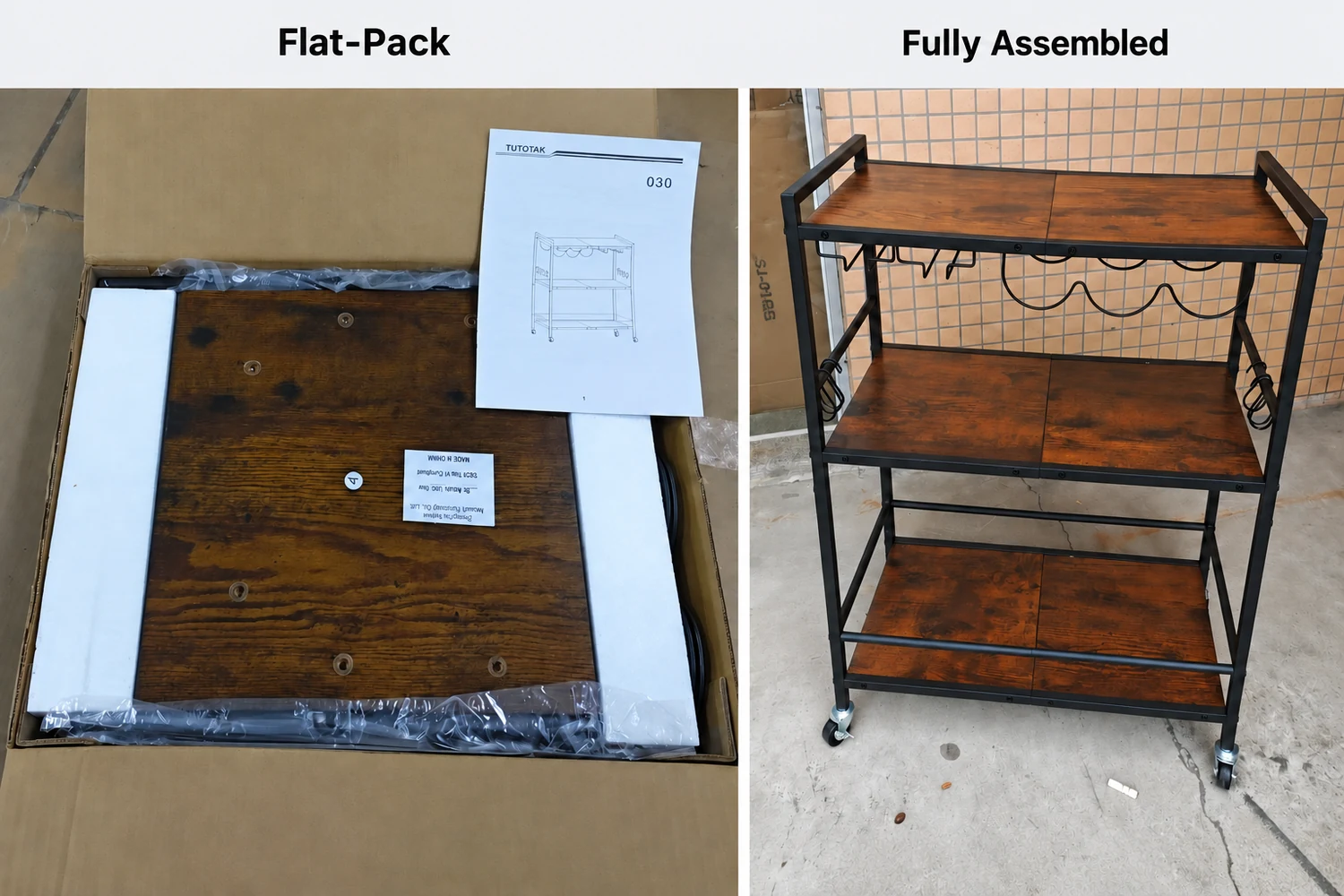
Flat-pack, semi-assembled and fully assembled furniture describe different delivery states, but the label alone does not define what the factory will build, what will be packed loose or what the buyer, retailer, installer or end customer must complete.
For importers, the useful comparison is therefore not “which format is always better?” It is whether the chosen format fits the product structure, sales channel, delivery route, installation plan, quality-control method and after-sales process for the specific project.
Direct Answer: What Should Importers Compare?
Confirm the exact state in which the product leaves the factory and the exact state in which it is expected to reach the next party. Then compare who performs each assembly task, which components and hardware are packed separately, the final carton count and packed data, the downstream installation work, the sample and QC evidence, and how parts or assembly issues will be handled after delivery.
A flat-pack design may allow components to be arranged in a more compact packed configuration, but the result depends on product geometry, protection, carton design and the intended route. A fully assembled product may move assembly work upstream to the factory, but that does not establish a universal cost, damage, durability or returns advantage. Semi-assembled furniture divides these responsibilities between stages. The buyer needs project-specific quotations and samples rather than a general winner.
Define the Actual Delivery State
The following are practical procurement definitions, not universal industry thresholds. Suppliers may use the same label for different pack-outs, so the quotation and sample record should describe the actual configuration.
| Delivery state | Practical meaning | What the buyer should confirm |
|---|---|---|
| Flat-pack / ready-to-assemble / knock-down | Major parts are packed separately and the main product structure is assembled after shipment. | Loose parts, factory-fitted hardware, hardware bags, included tools, manual revision, assembly sequence and final packed configuration. |
| Semi-assembled | Identified sections or mechanisms are assembled at the factory while other parts remain for later assembly or installation. | Which subassemblies are factory-built, which connections remain open, who completes them and whether the carton contains one or several product states. |
| Fully assembled / factory-assembled | The main furniture structure leaves the factory assembled for its intended use. | Whether handles, feet, shelves, restraint hardware, electrical modules or installation work remain; how the built unit is protected, handled and placed. |
“Fully assembled” should not be interpreted as “nothing remains to do” without confirmation. A product can arrive with its main cabinet assembled while still requiring a loose shelf, handle, leg, wall restraint or site installation. Likewise, a flat-pack product may contain pre-assembled drawers, frames or factory-fitted hardware. The component list, drawing, BOM and manual should identify the real state.
Assign Factory, Buyer and Installer Responsibilities
Assembly labor does not disappear when the delivery state changes. It moves between the factory, warehouse, retailer, installation team and end user. A useful quotation makes that allocation visible.
- Factory scope: identify factory-built subassemblies, fitted hardware, adjustments, protective preparation and any assembly checks included in the quotation.
- Packed contents: identify loose panels, frames, shelves, doors, hardware bags, tools, instructions, labels and any separate cartons.
- Downstream work: identify who unpacks, assembles, installs, fixes to a wall where applicable, adjusts doors or drawers, removes packaging and records completion.
- Exclusions: record work that is not included instead of assuming it belongs to the supplier, carrier, retailer or end customer.
The Furniture Product Specification Sheet should record the selected assembly state and point to the controlling drawings, BOM, hardware list, manual and packaging reference. This article owns the comparison decision; the specification-sheet guide owns the product-definition record after that decision is made.
Compare Packaging, Transport and Fulfillment Without Assuming the Outcome
Flat-pack construction can create an opportunity to nest or layer components, but a smaller-looking structure does not automatically produce a smaller or safer carton. Panel dimensions, frames, fragile surfaces, hardware, internal protection, movement control and carton thickness all affect the final packed unit.
Semi-assembled furniture may preserve selected factory-built relationships while leaving other components loose. Fully assembled furniture must be protected and handled in its built form, but the commercial effect still depends on the exact product, carton or protective system, pallet or vehicle arrangement and route. None of these labels proves a freight price, damage result, carrier acceptance or fulfillment classification.
Compare sealed carton dimensions, gross weight, carton count, carton identity and pack-out for the quoted version. Keep assembled dimensions separate from packed dimensions. Where marketplace, carrier or warehouse rules matter, verify the current program, market and service rather than applying one threshold to every route. The Flat-Pack Furniture Packaging Requirements guide owns the detailed carton, protection, label and packed-sample record.
Compare Installation Labor at the Correct Stage
A factory-assembled quotation may include more assembly work before packing. A flat-pack quotation may place more work after delivery. A semi-assembled quotation divides the work. That difference is commercially relevant, but it does not show which offer has the lowest total cost until the buyer adds the actual labor, handling, service and route assumptions for the target market.
Ask each supplier to describe the quoted assembly state and each downstream operation. If a retailer offers room-of-choice delivery, installation or packaging removal, price and responsibility for those services should be assessed separately from the factory unit price. If the end customer assembles the product, the buyer should review the instructions, part identification, required tools and support process for that exact revision.
Build QC Around the State That Will Be Delivered
Quality control needs a different emphasis for each delivery state, while still comparing the observed product and records with approved requirements.
- Flat-pack: verify part and hardware identity, quantities, hole and interface alignment, manual revision, packed-set completeness and assembly from an identified production-style carton.
- Semi-assembled: inspect the factory-built subassemblies, the interfaces left for later work and the remaining parts, hardware and instructions as one complete set.
- Fully assembled: inspect the factory-built product relationships and functions required by the specification, then review the protection and handling controls for the built unit.
An approved sample provides a reference for an identified scope; it does not by itself prove that mass production will conform. Inspection and packaging testing answer different questions. Use the Furniture Quality Control guide for inspection planning and the ISTA Packaging Testing guide for protocol, specimen, conditions and report-scope questions.
Plan After-Sales Handling Before the Order
The delivery state changes what can be identified and handled after a problem is reported. A flat-pack program may need reliable part codes, hardware identities and manual references so the buyer can distinguish a missing component from an assembly or product issue. A semi-assembled product requires the same distinction between the factory-built section and the work completed later.
For fully assembled furniture, the buyer should define whether a reported issue can be handled through an identified component, an adjustment, a local repair process or the complete unit. The correct approach depends on the product, market, contract and available service network. No delivery state alone proves easier service or fewer returns.
At minimum, keep the product and revision, component or subassembly identity, shipment or carton reference, photographs or inspection evidence and the agreed responsibility visible. If the product or pack-out changes, the Furniture Product Revision Control process should determine which drawings, BOMs, manuals, samples and packaging records require review.
A Flat-Pack Change Can Affect More Than the Carton
One approved HOMVND engineering case documents a furniture product moving from a single-panel configuration to split-panel revisions. The changes affected part identity, joining hardware, the assembly sequence and the packaging specification together. The case supports a narrow conclusion: changing how a product packs can require coordinated product and document changes. It does not establish universal freight, damage, fulfillment or return results.
The full evidence remains with the Furniture Sourcing Guide’s engineering example. For this comparison, the procurement lesson is to treat delivery state as part of the product definition—not as a carton label added after the design is finished.
Procurement Comparison Table
| Decision area | Flat-pack | Semi-assembled | Fully assembled |
|---|---|---|---|
| Product state at dispatch | Main structure remains for later assembly. | Named subassemblies are built; remaining connections stay open. | Main structure leaves the factory assembled. |
| Factory responsibility | Prepare components, interfaces, hardware, instructions and pack-out within the agreed scope. | Build and check defined subassemblies plus prepare the remaining set. | Build and check the defined factory-assembled product state. |
| Downstream responsibility | Complete the main assembly and any installation steps assigned to the destination party. | Connect, fit or install the remaining parts and verify the complete product. | Unpack, place and complete any specifically excluded fitting or installation work. |
| Packed-unit comparison | Review component layout, hardware organization, manual and protection. | Review the relationship between subassemblies, loose parts and protection. | Review protection and handling of the built geometry. |
| Sample validation | Assemble from the identified packed set. | Inspect factory-built sections and complete the remaining assembly. | Inspect the assembled product and its protected delivery state. |
| After-sales identity | Part, hardware and manual references may be central. | Separate subassembly issues from remaining-part or installation issues. | Define component, adjustment, repair or whole-unit handling according to the program. |
| Commercial conclusion | Compare project-specific quotations, packed data, labor scope, route assumptions and evidence. The delivery-state label does not establish a universal winner. | ||
What to Put in the RFQ and Validate in the Sample
| Decision point | Ask for in the quotation | Validate in the sample or approval record |
|---|---|---|
| Delivery state | Named flat-pack, semi-assembled or fully assembled state with a description of what that means. | Physical product and packed set match the stated configuration. |
| Components and subassemblies | Factory-built sections, loose parts, fitted hardware and excluded installation work. | Parts, subassemblies and interfaces match the current drawing and BOM references. |
| Assembly responsibility | Factory work, downstream work, required tools, instructions and any installation assumptions. | Complete the remaining work using the intended instructions, tools and sequence. |
| Packed unit | Carton count, sealed dimensions, gross weight, carton identity and proposed protection scope. | Measure and review the identified packed configuration and record open deviations. |
| QC evidence | Checkpoints tied to the selected delivery state and current references. | Observed product, assembly and packaging are compared with the approved requirements. |
| After-sales | Part identification, evidence request, support responsibility and handling path. | Part codes, manuals and product records can identify the supplied revision. |
The RFQ does not need to contain every final technical detail, but it should make known requirements and open assumptions visible. For the broader inquiry structure, use the existing RFQ Guide for Flat-Pack Furniture. Final values belong in controlled specifications and approval records rather than informal quotation notes.
Use a Five-Step Selection Framework
- Define the destination promise. State how the product should arrive, who receives it and what service the channel promises.
- Map the physical product. Identify which structures can remain loose, which should be factory-built and which installation steps are site-dependent.
- Assign responsibility. Record factory, warehouse, installer, retailer and end-user work without leaving labor or tools implicit.
- Compare like-for-like offers. Normalize the delivery state, carton data, included work, downstream labor assumptions, QC scope and after-sales responsibility.
- Validate the chosen state. Review an identified product and packed sample, close deviations and align the specification, BOM, manual, packaging record and revision status before production approval.
This framework is a procurement recommendation. It does not make one delivery state the default for every product. The wider Furniture Sourcing Guide covers supplier evaluation, development, approval, quality planning and production readiness around that decision.
Buyer FAQ
Is flat-pack furniture always cheaper to import?
No. Flat-pack construction may create a more compact pack-out opportunity, but total cost depends on the actual carton, quantity, route, handling, assembly labor, service scope and other commercial terms. Compare quotations and packed data for the same product definition.
Does fully assembled mean nothing needs to be fitted?
Not necessarily. Handles, feet, shelves, restraint hardware, electrical modules or site installation may remain outside the factory-built state. The supplier should describe what is fitted, loose or excluded.
Is semi-assembled furniture the same as flat-pack furniture?
Not as a procurement description. Semi-assembled normally indicates that named subassemblies are already built, but there is no universal threshold. Identify the actual subassemblies and remaining work.
What should a comparison sample prove?
It should let the buyer review the identified delivery state, components, hardware, factory-built relationships, remaining assembly, instructions, packed configuration and agreed QC points. Its identity, revision and open deviations should be recorded.
Which format is better for ecommerce furniture?
There is no universal answer. The decision depends on the product structure, target channel, packed-unit constraints, customer or installer responsibility, service model and evidence available for the proposed configuration.
Discuss a Flat-Pack Furniture Project
Use this comparison to define the delivery state before requesting final quotations. For a flat-pack furniture project within HOMVND’s confirmed scope, share the product reference, target market, sales channel, expected quantity, assembly expectations and known packaging constraints for a project-specific review.